

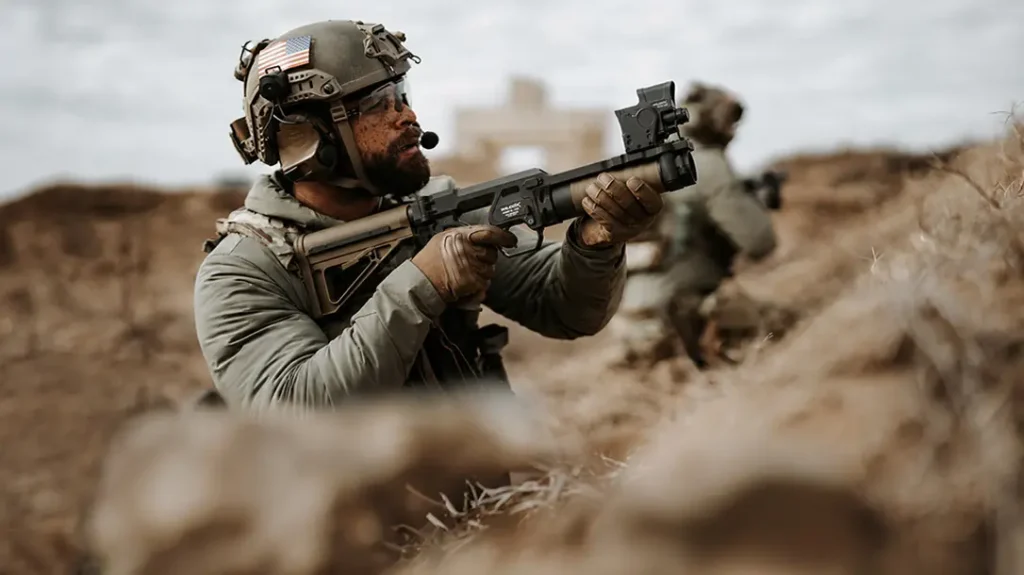
The MINI-GL40 from Wilcox Industries isn’t just another incremental upgrade—it’s a deliberate leap in how 40 mm firepower gets delivered to the fight. Where traditional grenade launchers have remained stubbornly analog, this compact launcher pairs a modern sighting suite with a lighter, more maneuverable package that shrinks the decision loop between spotting a target and putting a round on it. That matters because the 40 mm platform has always been the battlefield’s Swiss Army knife—smoke, illumination, high-explosive, less-lethal—yet shooters have historically paid for that versatility with weight, bulk, and slow target acquisition. Wilcox’s integration of advanced optics and fire-control electronics flips that equation, giving operators faster, more precise effects without sacrificing the launcher’s core utility.
For the 2A community the implications run deeper than military catalogs. Every time a manufacturer refines a platform that was once the exclusive province of government end-users, the technology and manufacturing know-how eventually diffuse into the civilian and law-enforcement markets. The MINI-GL40’s sighting architecture, once proven, could seed future civilian-legal 37 mm or flare-launcher variants, or at minimum accelerate the trickle-down of ruggedized optics and electronic ranging solutions that private citizens already rely on for precision rifle work. More importantly, it underscores a broader truth: innovation in small arms is driven by competition and demand, not by top-down edicts. When companies like Wilcox are free to iterate without the dead hand of import bans or regulatory choke points, the entire ecosystem—military, LE, and civilian—benefits from lighter, smarter, more capable tools.
At a moment when some policymakers still treat “grenade launcher” as a scare phrase rather than a legitimate engineering category, the MINI-GL40 quietly demonstrates why the right to keep and bear arms must include the right to keep and bear advancing arms. Suppressing that technological progress under the guise of public safety would simply freeze American shooters at 1960s-era capability while peer competitors continue to modernize. The launcher’s debut is therefore more than a product launch; it’s a reminder that the Second Amendment’s protections are most meaningful when they safeguard the ability of free citizens—and the companies that serve them—to push the frontier of what firearms can do.


