

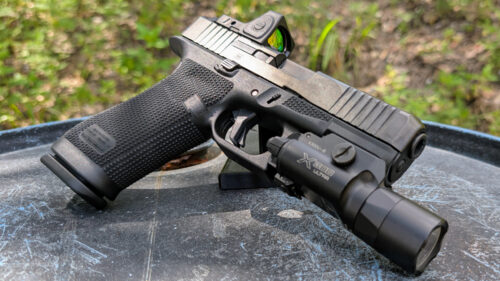
Maryland’s latest defense of its Glock-style pistol ban hinges on a dangerous legal fiction: that a handgun’s potential for illegal conversion somehow strips it of constitutional protection. The state essentially argues that because a criminal might someday attach an illegal auto-sear or “Glock switch,” the pistol itself should be treated like a machine gun and banned outright. That logic collapses under Heller and Bruen, which both protect arms “in common use” for lawful purposes; millions of Glock-pattern pistols sit in law-abiding hands nationwide, and the Supreme Court has never allowed future criminal misuse to redefine an otherwise ordinary firearm as unprotected. By equating the mere possibility of modification with the firearm’s inherent character, Maryland invites courts to green-light bans on virtually any semi-automatic that clever criminals might abuse—an approach that would gut the individual-right framework the Court has twice reaffirmed.
For the 2A community the stakes are immediate and practical. If Maryland’s theory prevails, states could justify sweeping restrictions on the most popular defensive handguns simply by pointing to aftermarket parts that are already illegal to possess or install. That would shift the constitutional inquiry from whether an arm is commonly owned by responsible citizens to whether government can imagine a prohibited configuration, effectively letting regulators ban first and ask questions later. Plaintiffs correctly note that such reasoning turns Bruen’s history-and-tradition test on its head, replacing objective evidence of founding-era analogues with speculative fears about modern criminals. The case is therefore less about one state’s statute and more about whether lower courts will allow creative re-labeling to evade the Supreme Court’s clear commands.
Longer term, the litigation offers a critical test of how aggressively the post-Bruen judiciary will police these end-runs. A win for Maryland would embolden other jurisdictions to classify popular pistols, rifles, and even shotguns as “easily convertible” and therefore regulable like machine guns, narrowing the practical scope of the Second Amendment without ever admitting they are doing so. Conversely, a decisive rejection would reinforce that common-use handguns remain protected regardless of hypothetical misuse, forcing states to defend restrictions with actual historical tradition rather than policy wish lists. Either outcome will shape not only Maryland’s gun stores and shooting ranges but the broader national conversation about whether the right to keep and bear arms can survive creative statutory redefinitions.


