

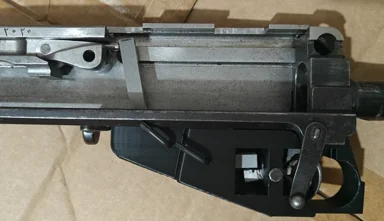
The Hotchkiss M1922 trigger-housing project is a textbook example of how 3-D printing is quietly rewriting the rules of the semi-auto game. By grafting an AR-15 fire-control group into the French machine-rifle’s lower, the designer has turned a century-old belt-fed curiosity into a modern, magazine-fed host that still wears its original lines. The cut-away housing and iterative lever geometry show a level of reverse-engineering that used to require a machine shop; now it’s a weekend of PLA+, calipers, and a file. That shift matters because it lowers the barrier between “I own a historic receiver” and “I can actually run it with contemporary ergonomics,” a direct exercise of the right to keep and bear functional arms.
What stands out is the deliberate engineering around legal and mechanical pinch-points. The oversized tabs that transfer trigger-pin load back into the metal lower, the trimmed rate-reducer pin, and the shortened Hotchkiss trigger itself all speak to a builder who understands both the physics of sear engagement and the gray zones of ATF letter rulings. By publishing pin lengths, infill percentages, and even wallet addresses for donations, the project treats the community as a distributed R&D lab rather than a passive customer base. That transparency accelerates refinement—V2 is already promised—while simultaneously documenting the entire process for anyone who might later need to argue “common use” or “readily convertible” in court.
For the broader 2A ecosystem, this is more than a clever hack; it’s a proof-of-concept that legacy receivers need not become inert wall-hangers. As polymer printers get cheaper and metal-sintering services proliferate, the same workflow could migrate to other inter-war and Cold-War designs whose factories have long since closed. The result is an expanding menu of shootable history that doesn’t rely on dwindling surplus imports or boutique custom shops. In short, the Hotchkiss-AR hybrid is a reminder that the Second Amendment’s technological frontier is drawn in layers of filament as much as in barrels of steel.


