

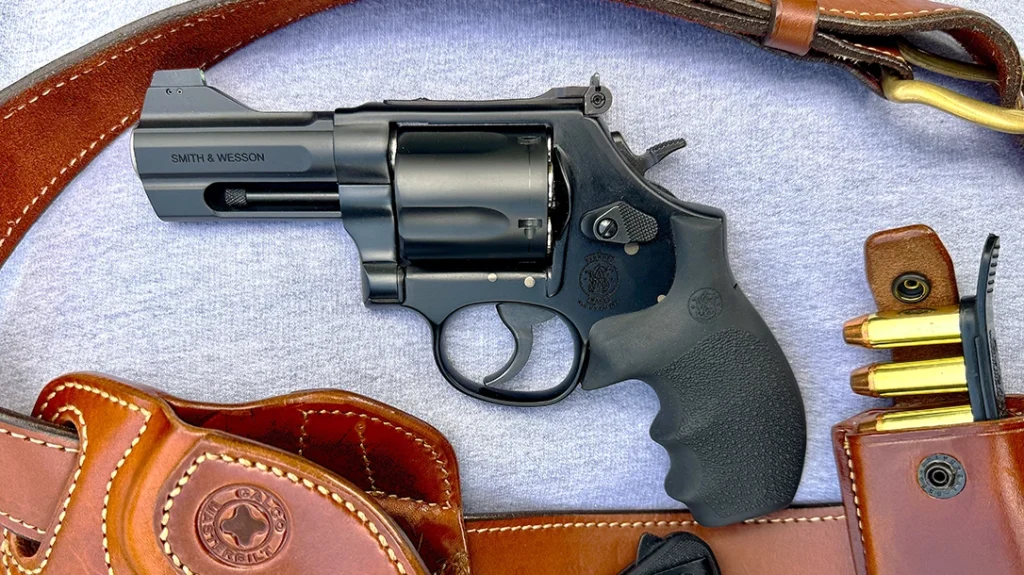
When Smith & Wesson first unveiled the Model 396 Airlite Ti at the 2000 SHOT Show, it was more than just another revolver—it was a bold experiment in lightweight metallurgy that paired a titanium frame with a five-shot .44 Special cylinder. That choice of cartridge was no accident; the .44 Special’s lower pressure curve let engineers shave weight without sacrificing the structural integrity needed for a defensive round, giving shooters a package that tipped the scales at roughly 19 ounces. Eight years later, the Nightguard variant added a matte-black finish and tritium night sights, transforming the gun from a curiosity into a serious low-light carry option that still weighed less than many .38 Special snubbies.
For the 2A community, the re-release of the 396 Nightguard is a reminder that innovation often circles back to what works. In an era dominated by polymer-framed, high-capacity pistols, a five-shot .44 Special revolver might seem anachronistic, yet its appeal lies in the very attributes that modern autoloaders struggle to match: absolute mechanical simplicity, no magazine to lose, and a cartridge whose recoil is manageable in a small frame. Lipsey’s decision to bring the gun back signals that there remains a market for purpose-built revolvers that prioritize shootability and reliability over capacity, a niche that continues to thrive precisely because it refuses to chase trends.
Beyond nostalgia, the Nightguard’s return underscores how titanium-frame technology has matured since the early 2000s. Early concerns about galling and longevity have largely been addressed through improved alloys and coatings, making the 396 a viable daily-carry choice rather than a range-only novelty. For concealed-carry permit holders who value a larger bullet diameter without the bulk of a .44 Magnum, the reintroduced model offers a rare combination: a defensive round proven in decades of law-enforcement use, housed in a frame light enough to ride comfortably under a cover garment. In short, Lipsey’s isn’t just reissuing a revolver; it’s reaffirming that the Second Amendment’s toolbox still has room for clever, old-school engineering that refuses to go out of style.


