

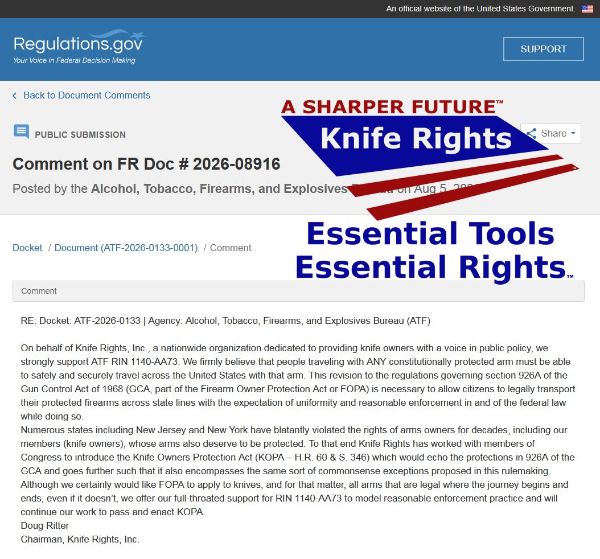
Knife Rights’ endorsement of the ATF’s proposed clarification on interstate firearm transport is more than a procedural nod—it’s a strategic alignment that underscores how the Firearm Owners’ Protection Act’s travel protections can serve as a template for broader rights expansion. By explicitly linking the rulemaking to their own Knife Owners’ Protection Act legislation, the group is reminding lawmakers and the public that the same constitutional logic—uniform national standards for lawful carry during interstate travel—applies equally to edged tools. This cross-pollination of advocacy is clever: it frames knife rights not as a niche hobby issue, but as a logical extension of the same individual-liberty principles that gun owners have spent decades codifying into statute.
For the 2A community, the move signals an opportunity to build durable, multi-issue coalitions that treat “shall not be infringed” as a continuum rather than a series of isolated skirmishes. When knife owners win explicit federal preemption against patchwork state bans, it creates precedent that can be cited in future challenges to magazine restrictions, feature bans, or permitting regimes that effectively disarm travelers. Conversely, if the ATF’s clarification stalls or is watered down, it hands anti-rights attorneys a precedent to argue that even long-settled firearm protections are perpetually negotiable—an outcome that would reverberate far beyond switchblades and stilettos.
The deeper implication is cultural. By publicly tethering knife and gun advocacy, Knife Rights is normalizing the idea that self-defense tools exist on a spectrum, all equally deserving of uniform national protection. That framing undercuts the “weapons of war” versus “common pocketknife” dichotomy that gun-control advocates rely on to divide the coalition. In an era when red-flag laws, sensitive-place restrictions, and permitting creep threaten to turn every state line into a constitutional minefield, a unified front that treats the right to carry—whether it’s a Glock or a gentleman’s folder—as a seamless civil liberty may prove more durable than any single-issue victory.


