

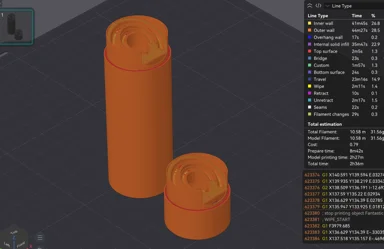
The KAW Mach3 FTN5 baffle inserts represent a clever evolution in the Form 1 suppressor space, where hobbyist ingenuity continues to outpace commercial offerings. By designing modular PLA+ inserts that drop into existing sectional linear compensators, the creator has essentially democratized the process of turning a muzzle device into a hearing-safe .22LR can—provided you follow the legal stamping requirements. The decision to leave the first chamber open as a blast chamber shows real attention to gas dynamics, while the recommendation for at least one three-inch section ensures both functional expansion volume and a practical surface for the mandatory Form 1 engraving. This isn’t just another remix; it’s a thoughtful refinement that addresses the shortcomings of earlier community designs.
What makes this particularly noteworthy for the 2A community is how it exemplifies the ongoing arms race between regulatory friction and technological accessibility. Rather than waiting for manufacturers to navigate the NFA’s bureaucratic maze, users are leveraging affordable 3D printing to create legal, customizable solutions that fit within existing product ecosystems. The fact that these inserts work with off-brand sectional compensators hints at a broader pattern: once a platform becomes popular, the community rapidly develops an ecosystem of improvements that extend its utility. It’s a microcosm of how the right to keep and bear arms has always been intertwined with the right to innovate—whether that’s filing the sear on a 1911 in 1911 or printing a baffle stack in 2024.
The implications extend beyond .22LR plinkers. As material science improves and more users experiment with higher-pressure cartridges, we’re likely to see this modular, insert-based approach migrate upward in caliber. That trajectory puts pressure on regulators who prefer to treat suppressors as exotic accessories rather than the safety equipment they are. Every successful Form 1 build that demonstrates measurable dB reduction without exotic materials or specialized tooling chips away at the argument that these devices require heavy-handed federal oversight. In that sense, the KAW Mach3 inserts aren’t just a neat print—they’re another data point in the long-running debate over whether the Second Amendment protects tools or merely the idea of tools.


