

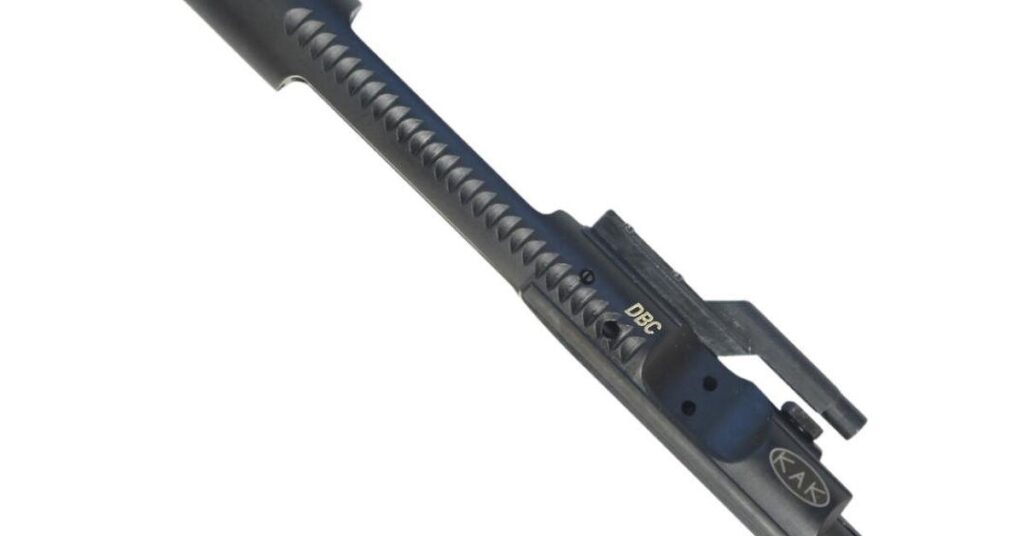
KAK Industry’s new Dead Blow Carrier isn’t just another bolt carrier—it’s a clever engineering response to the mechanical demands of forced-reset triggers. By borrowing the weighted, anti-bounce architecture once used in Colt’s 9 mm SMG carriers, the DBC keeps the bolt group moving in precise rhythm with the trigger’s reset spring, reducing the “short-stroking” that can plague FRTs in standard carriers. The internal weights act like miniature dead-blow hammers, soaking up excess energy on the forward stroke and feeding it back on the return, so the trigger bar is presented to the sear at exactly the right instant. In practical terms, that means fewer light primer strikes, smoother strings, and a higher probability that the rifle stays in the legal semi-auto envelope even when the shooter’s finger stays planted on the trigger.
For the 2A community the significance runs deeper than faster follow-up shots. Every time a manufacturer ships a purpose-built part that makes an FRT run reliably, it undercuts the ATF’s narrative that these triggers are “easy to convert” into machine guns. The DBC is evidence that the market is solving the engineering problem with drop-in, ATF-compliant components rather than illegal modifications—an argument that matters in courtrooms and on Capitol Hill. It also signals that the forced-reset category is maturing from garage tinkering into mainstream product development, which usually precedes broader acceptance and, eventually, economies of scale that bring prices down for everyone.
The larger implication is that innovation itself has become a form of activism. While anti-gun regulators try to freeze technology at 1986 definitions, companies like KAK are iterating on 19th-century mechanical principles—weights, springs, timing—to keep civilian rifles both fun and legal. If the DBC performs as advertised, expect copycat carriers from other makers and a quiet expansion of what shooters consider “normal” equipment. That quiet expansion is exactly how rights are preserved: not by dramatic court wins alone, but by thousands of small mechanical improvements that make prohibition logistically and politically impractical.


