

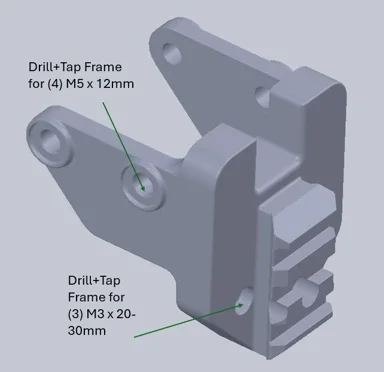
The HWW Pillager rear backplate Picatinny adapter represents a clever evolution in the DD19.2 ecosystem, transforming what was once a fixed rear interface into a modular mounting platform that opens entirely new possibilities for brace configurations. By requiring users to drill and tap their own M3 and M5 holes, this design deliberately places the final responsibility—and the final customization—in the builder’s hands, reinforcing the DIY ethos that has always defined the guncad movement. The 100% infill recommendation isn’t just about strength; it’s a tacit acknowledgment that this component will bear the full rearward force of a braced firearm, making material integrity non-negotiable.
What makes this adapter particularly significant is how it bridges the gap between the Pillager’s minimalist, competition-oriented frame and the practical realities of modern pistol stabilizing devices. Rather than forcing builders into a one-size-fits-all rear configuration, HWW has created a standardized interface that accepts any Picatinny-compatible brace or stock adapter, effectively future-proofing the platform against evolving ATF regulations and brace designs. This modularity mirrors the same philosophy that made AR-15s dominant—interchangeable components that let users adapt their firearms to specific needs without replacing the entire platform.
For the 2A community, this represents more than just another printable part; it’s a statement about ownership and adaptability in an era of increasing regulatory pressure. By empowering builders to create their own mounting solutions rather than relying on pre-configured options that might later be restricted, HWW is reinforcing the principle that the right to keep and bear arms includes the right to configure those arms as one sees fit. The adapter’s existence suggests that the guncad community continues to prioritize flexibility and user agency over convenience, ensuring that even as external pressures mount, the fundamental capability to customize and adapt remains firmly in the hands of the individual builder.


