

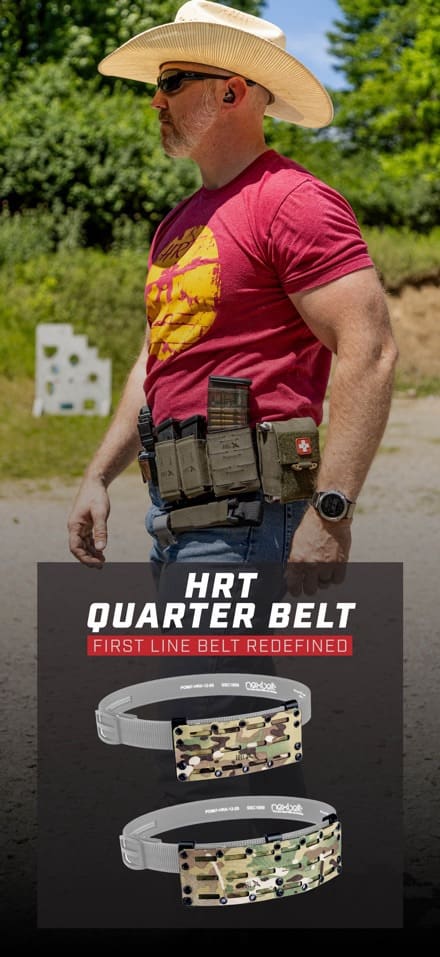
The Quarter Belt from HRT Tactical Gear isn’t just another piece of nylon with extra buckles—it’s a direct response to how real-world carriers actually operate. Most belt systems still assume you’ll either run everything or nothing, which forces shooters into awkward compromises when the day shifts from a flat-range session to a medical class or a low-profile carry day. By letting users pre-build modular “quarter sections” and swap them onto a standard 1.5-inch inner belt with a quick-clip interface, HRT has essentially turned the belt into a living document of your loadout rather than a fixed commitment. That flexibility matters for the 2A community because it lowers the friction between training, everyday carry, and duty use without requiring an entire new rig every time the mission profile changes.
What stands out is how this design quietly challenges the all-or-nothing mindset that has dominated tactical gear marketing for years. Instead of selling another “do-it-all” battle belt that ends up too heavy for most civilians or too conspicuous for everyday movement, the QTR system acknowledges that most responsibly armed citizens need to scale capability up and down on short notice. Pre-configuring sections for medical, less-lethal, or range-specific tools means you can keep a single inner belt and rotate only the outer capability you actually need that day. It’s a practical evolution that respects both the legal realities of concealed carry and the training discipline that says you should train with the gear you’ll actually carry.
For the broader Second Amendment ecosystem, this kind of modularity reinforces a core principle: gear should serve the user’s rights and responsibilities, not dictate them. When a belt system lets you stay light for daily life yet instantly scale to a more capable configuration without rebuilding from scratch, it removes one more artificial barrier between citizens and competent self-defense. That matters in an environment where training time, legal carry restrictions, and personal risk profiles are constantly shifting. HRT’s Quarter Belt may look like a simple hardware update, but it’s really an argument for treating your kit as an adaptable toolset rather than a static uniform—an argument the 2A community has been making for years and is finally seeing reflected in product design.


