

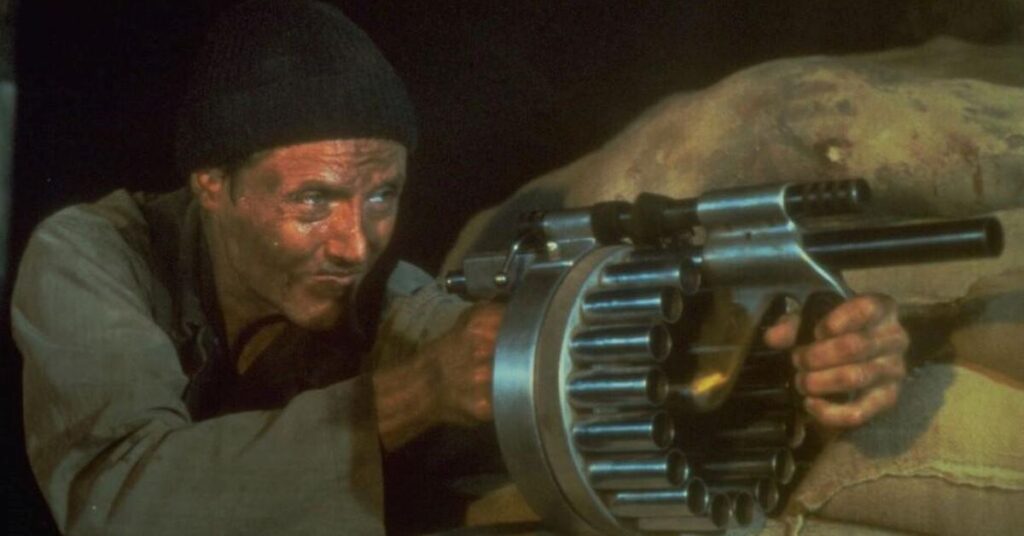
It’s one of those rare moments when Hollywood didn’t just reflect gun culture—it accidentally invented a new corner of it. In 1967, while filming a mercenary picture set amid the chaos of Biafra’s civil war, the production needed a compact, belt-fed machine gun that looked menacing yet could be handled by actors on the move. No such weapon existed in the real world, so armorers cobbled together a short-barreled, drum-fed hybrid that fired from an open bolt and accepted standard MG42 belts. The prop never left the soundstage in any official capacity, yet photographs and behind-the-scenes footage leaked into gun magazines and mercenary memoirs; within a few years, a handful of specialist armorers were machining near-identical receivers for private military contractors who wanted the same “run-and-gun” firepower without lugging a full-sized GPMG.
What makes the episode fascinating for Second Amendment advocates is how it illustrates the creative, almost Darwinian speed at which civilian and para-military tinkerers respond to perceived tactical gaps. The fictional gun filled a niche the regulatory state had never contemplated—something between an SMG and a light machine gun, easily converted to semi-auto or burst for stateside collectors. That same inventive impulse now drives today’s brace-equipped pistols, binary triggers, and short-barreled “other” firearms: when the market spots an unmet need, builders will meet it, movie prop or not. The Biafran hybrid thus stands as an early proof-of-concept that the right to keep and bear arms isn’t static; it expands whenever imagination collides with metallurgy.
More broadly, the episode underscores why cultural artifacts like films matter to the 2A community. They plant seeds of desire and technical possibility that later bloom into litigation, legislation, and new products. Suppressors went from obscure to mainstream once movies normalized their use; the same trajectory is now visible with binary triggers and 50-round drums. Regulators may try to freeze technology at 1986 or 1934, but the cultural conversation never stops—and neither does the American gunsmith at his mill.


