

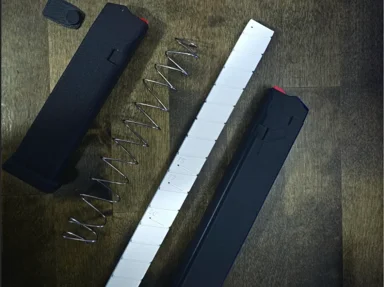
The Glock Magazine Spring Jig represents a fascinating evolution in the 3D-printed firearms ecosystem, where hobbyists are systematically dismantling the last remaining barriers to fully home-manufactured magazines. By expanding the original 0xdb1b design to accommodate 15, 17, 20, and 30-round configurations, this jig transforms what was once a specialized manufacturing process into something accessible to anyone with basic hand tools and wire stock. The inclusion of multiple start holes isn’t just convenience—it’s a deliberate nod to the reality that Glock owners often maintain mixed-capacity magazines for different use cases, from concealed carry to range training. The annealing step mentioned in the instructions is particularly telling; it acknowledges that while 3D printing has democratized frame and receiver production, springs remain the final frontier where material science still matters.
What’s striking about this development is how it addresses the weakest link problem in homemade magazine construction. Traditional magazine springs require precise tension curves and fatigue resistance that 3D-printed alternatives simply cannot match, but this jig bridges that gap by enabling users to create proper music wire springs with controlled geometry. The 30mm extra wire allowance for follower stability shows practical experience rather than theoretical design—someone has actually tested these springs under real-world conditions. For the 2A community, this represents another incremental victory in the broader strategy of making every component of a firearm manufacturable outside traditional supply chains, reducing dependency on commercial vendors who might face regulatory pressure.
The implications extend beyond individual convenience into the realm of supply chain resilience. When magazine springs can be fabricated from generic wire stock using a $5 print and basic hand tools, the entire concept of high-capacity magazine bans becomes an exercise in futility—much like trying to regulate ammunition by controlling brass casings. This jig, along with similar developments in follower design and floorplate manufacturing, suggests we’re approaching a point where the only limiting factor in magazine production will be the user’s willingness to invest time rather than money. The open acknowledgment of potential flaws in the design, coupled with the invitation for community feedback, exemplifies the collaborative improvement model that has made the firearms printing community remarkably effective at rapid iteration and problem-solving.


