

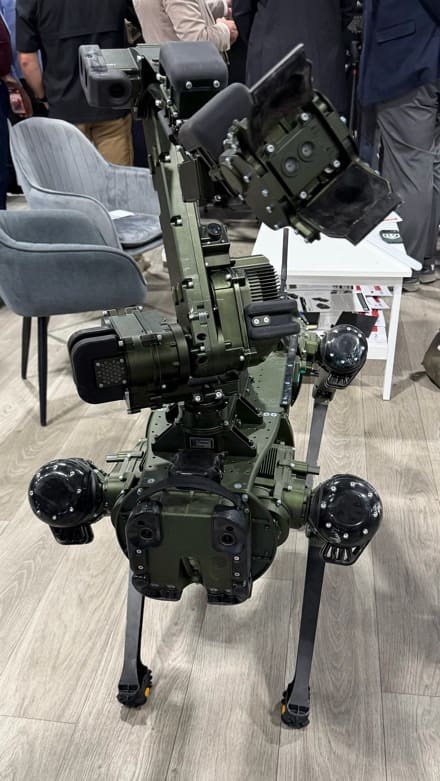
Ghost Robotics’ move into serial production of a six-degree-of-freedom manipulator arm for the Vision 60 quadruped isn’t just another incremental upgrade; it’s a clear signal that legged unmanned systems are graduating from reconnaissance platforms to true force-multipliers. Where earlier UGVs were largely limited to “look but don’t touch,” the new arm—now pushing a full meter with software-driven dexterity—lets operators open doors, manipulate switches, or safely handle suspicious packages without exposing personnel. For the 2A community that has long argued that technology should flow to citizens as readily as it does to government agencies, this development underscores a widening capability gap: law-enforcement and military units can already field robotic “hands” that private owners are still struggling to acquire at any price.
The deeper implication lies in how quickly software refinements are outpacing hardware changes. Ghost’s emphasis on iterative code updates means that once the arm is in the wild, its utility can be expanded through firmware pushes rather than new metal purchases—an approach that mirrors the open-source ecosystem many gun owners already rely on for optics, triggers, and ballistics apps. If similar modularity reaches the civilian market, lawfully armed Americans could one day deploy compact, legged robots for ranch security, rural search-and-rescue, or training scenarios without running afoul of NFA rules on Title II items. Conversely, if regulators treat these platforms as “destructive devices” or attempt to restrict their export to non-LEO buyers, the 2A community will have fresh ground to argue that defensive robotics are modern analogues to the militia’s historical access to the most effective arms of the day.
Ultimately, the Vision 60’s production-ready arm crystallizes a broader truth: autonomy plus manipulation equals force projection at a distance. Whether that force is used to clear a building ahead of a SWAT team or to let a landowner inspect a suspicious fence line without leaving cover, the hardware is here. The policy fight over who gets to own and operate it is only just beginning, and the 2A community would be wise to treat robotic appendages as the next front in the struggle to keep emerging technology in the hands of the people rather than locked behind bureaucratic gates.


