

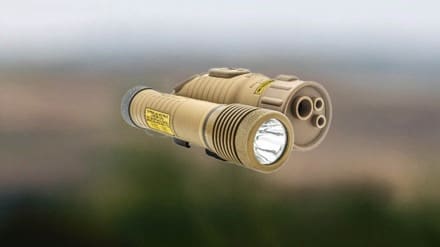
Rheinmetall’s fresh multi-hundred-million-euro call-off for thousands more LLM-VarioRay modules is more than a routine Bundeswehr procurement; it’s a real-world stress test of what a modern, modular aiming and illumination package can do when mated to a next-generation service rifle. The VarioRay’s ability to toggle between a visible green laser, infrared pointer, and variable white-light output in a single, rail-mounted unit gives German troops a decisive edge in both urban night-fighting and long-range engagements—capabilities that U.S. civilian shooters have been piecing together piecemeal with aftermarket lasers, weapon lights, and pressure switches. The fact that Berlin is willing to lock in six-figure quantities through 2032 signals that these integrated systems are no longer exotic add-ons; they are becoming baseline equipment for any serious fighting rifle.
For the American 2A community the lesson is straightforward: the same technologies that foreign militaries are standardizing on are already available, or soon will be, in the civilian market—provided legislators and regulators don’t choke off access under the guise of “military-grade” restrictions. Every time a European army validates a compact, multi-function aiming module, it accelerates economies of scale that eventually trickle down to American gun owners in the form of lighter, brighter, and more reliable options. Conversely, if domestic lawmakers treat these tools as inherently suspect, U.S. shooters risk being left with 1990s-era tech while peer competitors field systems that were proven in Bundeswehr trials.
The larger implication is strategic as well as commercial. Rheinmetall’s framework contract, repeatedly topped up by the Bundestag, shows how quickly a NATO ally can surge small-arms accessories once political will and funding align. That same surge capacity could be mirrored stateside if the domestic defense industrial base is allowed to sell advanced aiming and illumination gear without fear of retroactive reclassification or import bans. In short, the Bundeswehr’s laser-light bet is a reminder that the future of the fighting rifle is converging on integrated electro-optics—and that the Second Amendment community has both a stake and a competitive interest in making sure those tools remain legal, affordable, and American-made.


