

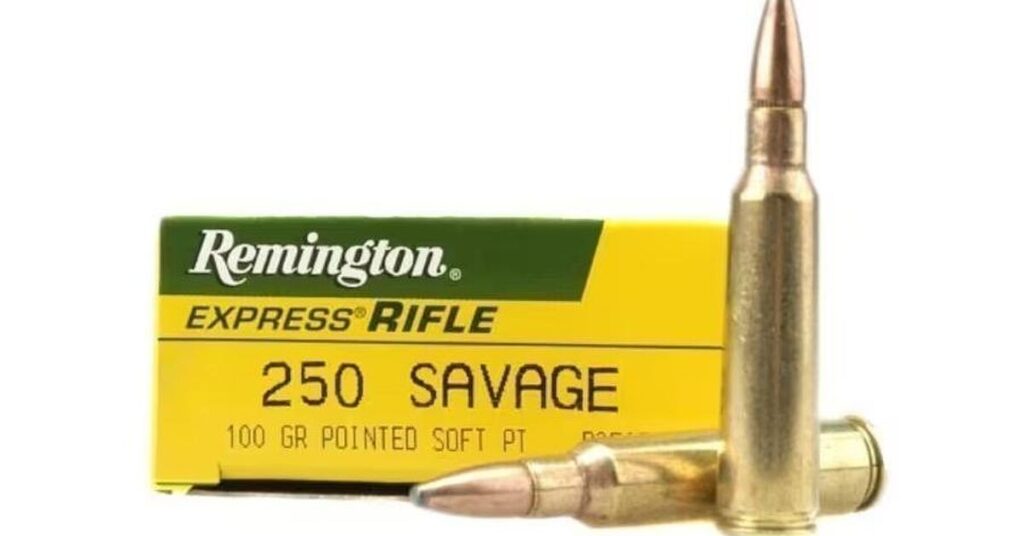
Before the world wars, the lever-action rifle was the whitetail hunter’s daily driver, and its favorite cartridges—rounds like the .33 Winchester, .303 Savage, and the venerable .44-40—were chosen more for what they could do inside thick timber than for what they could do on a ballistic chart. Those straight-wall, moderate-velocity loads delivered decisive performance at woods ranges, yet their comparatively low sectional density and modest velocity left them wanting once open-country shooting and longer shots became fashionable. The .250-3000 Savage arrived as the first widely popular bridge between those old lever-gun loads and the high-velocity pointed-bullet era; by pushing a 87-grain bullet past 3,000 fps, it proved that a small-diameter projectile could be driven fast enough to expand reliably and still retain the flat trajectory hunters craved. That demonstration cleared the runway for the .243 Winchester, whose slightly larger case and heavier 100-grain options gave it the versatility to dominate both varmints and deer, effectively making the .250-3000 the proof-of-concept round that let the .243 become a household name.
For the Second Amendment community, this evolution is more than a footnote in reloading manuals; it is a case study in how innovation and individual choice have always outpaced regulatory fashion. Each new cartridge that improved terminal performance or shooter enjoyment was born not from government mandate but from tinkerers, small companies, and private demand—exactly the ecosystem the Founders protected when they wrote “shall not be infringed.” When modern proposals surface that would ban “old” lever-actions or restrict “modern” precision rifles under the same vague “assault weapon” umbrella, the historical record reminds us that yesterday’s lever guns were once the cutting edge, and tomorrow’s optics-ready MSR may simply be the next logical step in the same continuum of lawful self-improvement. Preserving the right to keep and bear the arms we actually want to shoot—whether a century-old .44-40 or a contemporary .243—keeps that continuum alive and keeps government from deciding which increments of progress are permissible.


