

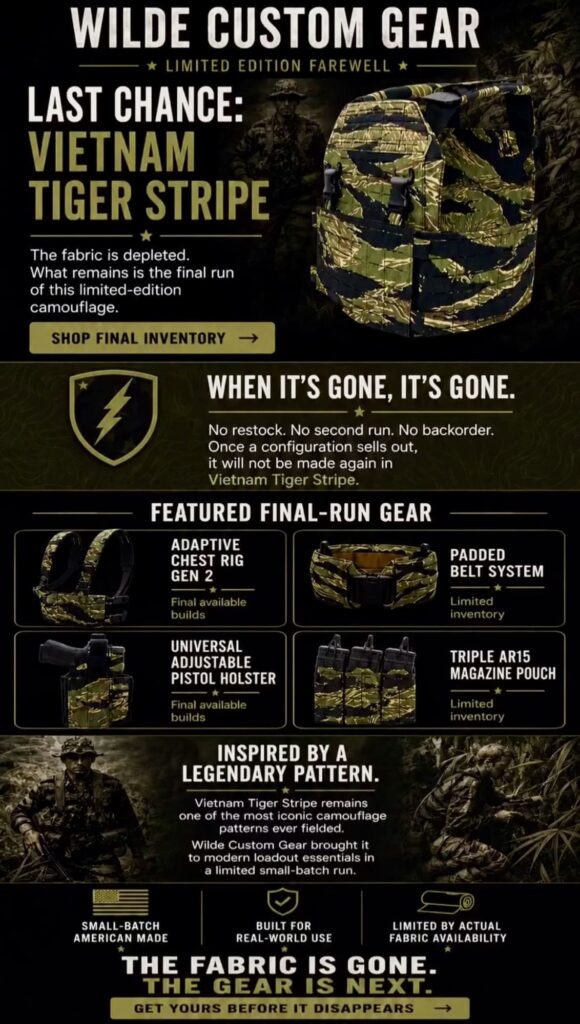
The final Tigerstripe run from Wilde Custom Gear isn’t just another limited-edition drop—it’s the closing chapter on a pattern that once defined an entire generation of American fighting men. Vietnam-era Tigerstripe was never issued in the volumes of woodland or desert camo, yet its scarcity only amplified its mystique; soldiers who managed to score a set often treated it like contraband treasure, trading, bartering, and customizing until the fabric itself became a badge of identity. By exhausting the last bolts of authentic material, Wilde isn’t simply clearing inventory—they’re sealing off a supply line that can’t be reopened without diluting the pattern’s historical integrity, a move that resonates with a 2A community already attuned to the fragility of legacy manufacturing.
For Second Amendment advocates, the disappearance of this fabric carries a sharper edge than mere nostalgia. Every bolt that vanishes is another reminder that small-batch, American-made tactical gear exists at the mercy of global supply chains and shifting political winds; when the looms stop and the dye lots run dry, no amount of demand revives them. Collectors who snap up the remaining plate carriers, chest rigs, and pouches aren’t just preserving aesthetics—they’re archiving functional equipment whose lineage traces directly to the same constitutional right that lets civilians own the very firearms these rigs were designed to support. In that sense, the last Tigerstripe pieces function as both practical kit and quiet protest against the slow erosion of domestic production capacity.
The broader implication is unmistakable: once these configurations sell out, the pattern effectively exits the civilian market in its historically accurate form. Future runs will either be reproductions printed on inferior substrates or outright fabrications that trade authenticity for availability. For enthusiasts who value provenance as much as performance, the choice is binary—secure a piece of that lineage now or accept that the next generation of gear will carry the name without the story. Wilde’s decision to let the fabric dictate the end date underscores a principle the 2A community understands instinctively: rights and resources alike require active stewardship, because both can vanish without ceremony if left unattended.


