

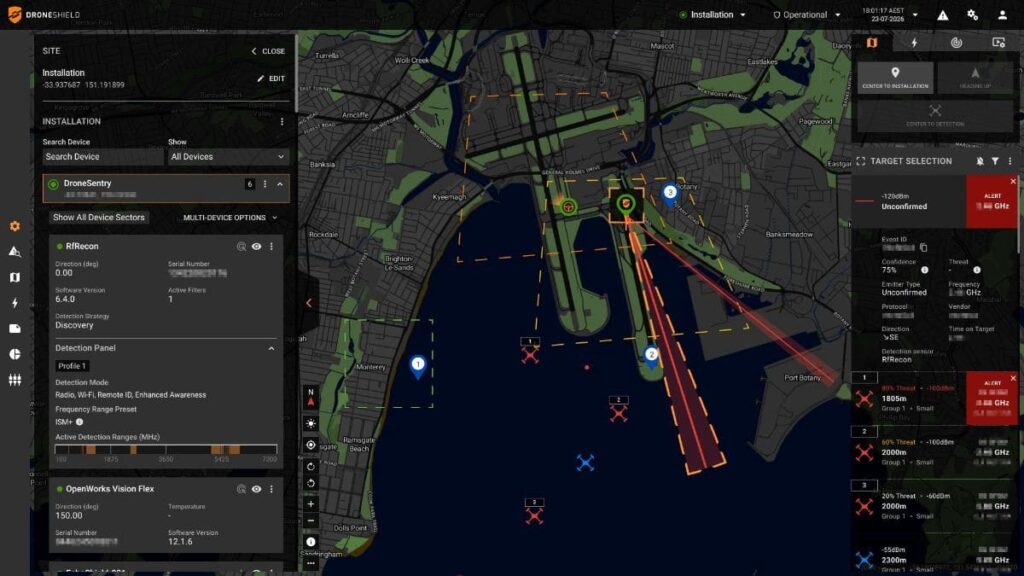
DroneShield’s new RfAI-3 engine is more than an incremental upgrade; it’s a quiet admission that the drone threat has outrun the old playbook. Where earlier generations of RF detection relied on known signatures—essentially a “most-wanted” list of drone transmissions—RfAI-3 learns the radio-frequency environment itself, flagging anything that behaves like a drone even if the airframe or protocol has never been catalogued. That shift matters because the next wave of small UAS won’t come from Shenzhen with off-the-shelf radios; they’ll be 3-D-printed airframes running open-source flight stacks and ad-hoc mesh networks. If the sensor can’t generalize, it’s already obsolete.
For the 2A community the lesson is straightforward: the same technology that can spot an unseen quadcopter over a forward operating base can also be turned on lawfully armed citizens at a public range or private property. Once an algorithm decides that “unusual RF behavior” equals “threat,” the decision loop no longer needs a human to confirm a visible firearm—only an anomalous signal. The companies selling these systems market them as defensive tools for airports and stadiums, yet the underlying code doesn’t carry a Second Amendment carve-out. The moment detection becomes pre-crime, the burden of proof flips from the state to the citizen.
What RfAI-3 really signals is that the counter-drone market is maturing from narrowband receivers into adaptive, AI-driven surveillance layers. That capability will inevitably trickle down to municipal police departments and, eventually, to private security firms under the banner of “public safety.” The 2A response isn’t to ban the technology; it’s to insist on transparent audit logs, human-in-the-loop confirmation, and strict warrants before any autonomous sensor hands actionable data to law enforcement. Otherwise the same paradigm that now claims to protect the skies will quietly redefine what counts as suspicious behavior on the ground.


