

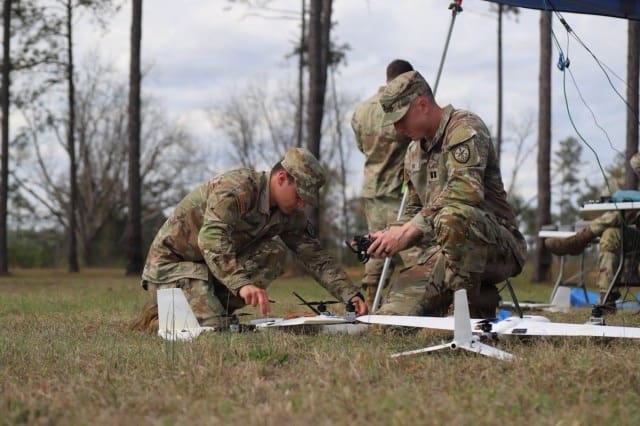
The Army’s latest drone push at Fort Gordon isn’t just another tech upgrade—it’s a signal that the service is betting its future edge on small, networked unmanned systems that can be built, hacked, and fielded faster than traditional acquisition cycles allow. By pairing Maryland-based cyber developers with the 11th Cyber Warfare Battalion’s tactical team, the project shows how quickly the military is folding commercial drone hardware into its kill chain, then hardening it against the very electronic-warfare threats that will define the next fight. For the 2A community this matters because the same open-source flight controllers, FPV video links, and mesh-network radios that soldiers are now stress-testing are the exact components civilians can still buy off the shelf—until someone decides they’re “dual-use” and needs a new rule to control them.
What the Army is learning in these labs will almost certainly migrate into the regulatory conversation around civilian drones. Once the service proves that a $500 quadcopter can be turned into a persistent ISR or loitering-munition platform with a few lines of code and a Raspberry Pi, expect renewed pressure to add geofencing mandates, remote-ID expansions, or even component-level export controls that treat hobby-grade autopilots like restricted munitions. The 2A angle is straightforward: every new restriction justified by “national security” on the civilian side narrows the pool of legal hardware and software that private citizens can use to train, experiment, or simply fly recreationally. If the same parts that let a teenager race quads on the weekend become the backbone of tomorrow’s platoon-level drone swarm, the line between sporting equipment and battlefield tool will be drawn by bureaucrats, not by shooters.
The deeper implication is cultural. The military’s embrace of rapid, bottom-up innovation—soldiers writing their own firmware in weeks instead of waiting for a five-year program of record—mirrors the decentralized, garage-to-frontline ethos that has always defined the American gun culture. That same spirit is what keeps civilian innovation ahead of government timelines, whether it’s 3-D-printed lowers or open-source flight stacks. The risk is that the very success of these cyber-drone teams will be used to argue that only the state can be trusted with such tools, quietly shifting the Overton window until private ownership of advanced unmanned systems is treated as inherently suspect. The 2A community’s job is to watch these experiments, document the dual-use components, and push back the moment regulators try to turn today’s Army lab project into tomorrow’s civilian ban.


