

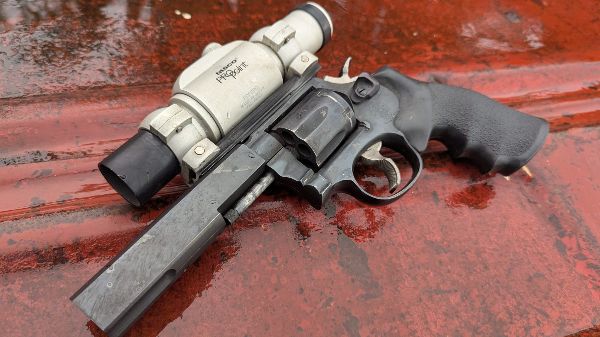
The Smith & Wesson Model 10-8 sits at the intersection of blue-collar reliability and high-level tinkering, a revolver that began life as a duty-issue .38 Special and ended up as a bespoke competition piece. What makes this particular gun fascinating isn’t just the aftermarket work—custom barrels, tuned actions, and competition-grade sights—but the fact that someone poured that level of effort into a platform most modern shooters would dismiss as “just a wheelgun.” In an era where striker-fired pistols dominate the leaderboard, this 10-8 proves the revolver still offers a tactile, mechanical advantage that rewards skill over capacity. For the 2A community, it’s a reminder that rights aren’t preserved by the newest polymer frame alone; they’re kept alive by people who understand, maintain, and improve the mechanical heritage that predates every magazine ban or feature restriction.
That heritage matters because the Model 10 line has survived more than a century of regulatory whiplash—from the 1934 National Firearms Act through the 1994 assault-weapons ban and today’s state-level magazine limits—yet remains fundamentally unchanged in its core design. A heavily customized 10-8 therefore functions as both a functional tool and a quiet act of cultural preservation: every polished cylinder and hand-fitted part is an argument that lawful citizens have both the right and the competence to own and refine older platforms. When anti-gun voices claim “no one needs” a revolver for anything beyond nostalgia, this gun quietly refutes them by demonstrating real-world accuracy and shootability that still beats many contemporary options on a dollar-for-dollar basis. In short, the 10-8 isn’t just a lucky find; it’s living proof that the Second Amendment protects an evolving ecosystem of firearms, not a frozen museum exhibit.


