

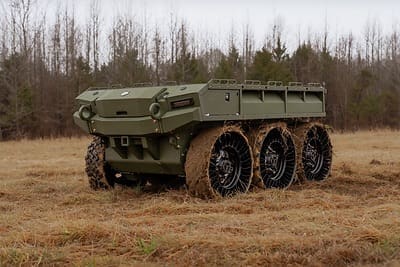
The Army’s decision to put the Hunter WOLF through its paces with the 82nd Airborne isn’t just another procurement trial—it’s a live-fire referendum on whether small, lethal robotic systems can keep up with the fastest, lightest infantry in the force. By folding the six-wheeled UGV into a Transition in Contact drill at Fort Polk, the service is essentially stress-testing the idea that a man-portable robot can haul ammo, sensors, and even crew-served weapons across the same drop zones and double-canopy that paratroopers have used since Normandy. For the 2A community, that matters: every time a UGV proves it can lighten a squad’s load or extend its eyes and trigger finger without adding bodies, it strengthens the argument that armed citizens—not just soldiers—should have access to the same class of force-multiplying tools.
What makes the WOLF different from the bigger, logistics-heavy platforms that usually hog defense headlines is its throw-it-out-of-a-C-17-and-forget-it profile. At roughly man-sized and battery-or-fuel-flexible, it can ride down on the same static line as the riflemen it supports, then be re-tasked by a junior NCO with a tablet instead of a dedicated roboticist. That kind of democratized control mirrors the decentralized responsibility that defines an armed society; if a two-man team can own the “last mile” of autonomous overwatch, the same logic scales to a prepared citizen who might need eyes on a back pasture or a trail cam that can also return fire. The Army’s willingness to let the 82nd kick the tires in a no-kidding field exercise quietly ratifies that vision.
Longer term, the data collected at Fort Polk will shape not only future budget lines but also the regulatory climate around armed robotics. If the WOLF demonstrates reliable IFF, positive control, and scalable lethality, it becomes harder for anyone—DoD or DHS—to claim that only government operators can be trusted with such systems. Conversely, any repeat of the usual procurement theater—feature creep, gold-plated specs, vendor lock-in—will give the 2A world fresh evidence that the same bureaucratic reflexes threatening magazine bans and “assault weapon” rules are also stifling the tools that could keep small units alive. Either way, the 82nd’s after-action review is about to become required reading for anyone who believes the Second Amendment covers the future, not just the past.


