

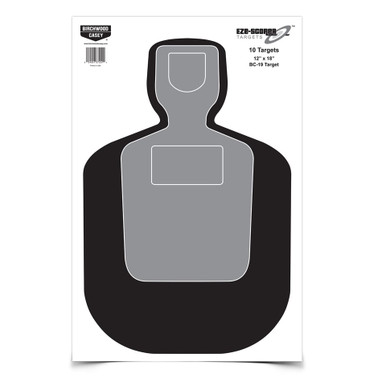
Birchwood-Casey’s compact 12-by-18-inch “Shadow Target” punches well above its size when shooters need a realistic, portable option for qualification and defensive practice. Because the silhouette is scaled for the distances most civilian encounters actually occur—inside twenty-five yards—trainers in HR-218 programs have quietly adopted it as the go-to paper for requalifying off-duty and retired law-enforcement personnel. The reactive surface gives an immediate, high-contrast hit indicator that stays visible even under midday sun, eliminating the need for spotters or walk-downs and letting shooters maintain a higher round count in the same range session.
What makes the target more than just another piece of paper is the way it quietly reinforces the legal and practical realities of armed self-defense. By shrinking the vital zone to match real-world defensive distances, the Shadow Target discourages the “spray-and-pray at fifty yards” mindset that creeps into some qualification courses. Instead, it rewards the controlled pairs and failure-to-stop drills that actually translate to parking-lot or hallway encounters—the very scenarios that Second Amendment carriers are statistically most likely to face. At roughly the price of a fast-food combo, the target also lowers the barrier to frequent practice, an under-appreciated factor in building the “regularly engaged in lawful training” record that courts and juries increasingly look for when judging reasonableness.
For the broader 2A community, the popularity of this unassuming rectangle is a reminder that effective marksmanship doesn’t require a private bay or a $500 electronic system; it requires repetition at distances that mirror the fight you’re most likely to get. Departments that quietly switched to the Shadow Target for HR-218 shoots are inadvertently validating what private citizens have known for years: if the qualification standard is realistic, the citizen who meets it is both safer and legally better positioned. In short, a twelve-by-eighteen-inch piece of paper is doing more to keep armed Americans proficient than many multi-thousand-dollar training initiatives—and it’s doing it at a price point that keeps the focus on skill, not gear.


