

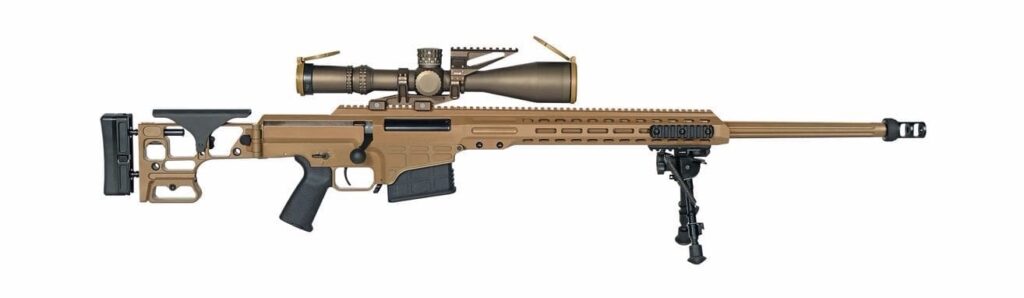
Barrett’s move to bring 6.8×51 mm capability to the MRAD MK 22 isn’t just another caliber option—it’s a direct bridge between the Army’s next-generation NGSW program and the precision-rifle market that civilian shooters actually buy. By engineering a conversion kit around the same high-pressure cartridge that powers the M7 and M250, Barrett is signaling that the commercial aftermarket will soon have access to the same terminal-performance leap the military is betting on. That matters because the 6.8×51 mm round was designed from the ground up to defeat modern body armor at extended ranges; once factory ammunition and conversion components trickle down, precision shooters gain a legitimate step up in barrier penetration and retained energy without having to adopt an entirely new rifle platform.
For the 2A community the timing is telling. The MRAD platform is already one of the few factory rifles that can be reconfigured across multiple calibers without losing headspace or accuracy guarantees, so Barrett is essentially future-proofing its flagship against whatever the next bureaucratic caliber fad might be. More importantly, the existence of an official 6.8×51 mm kit legitimizes civilian ownership of a round the government originally tried to keep inside the military-industrial complex. Every time a major manufacturer validates a “military-only” cartridge for the commercial market, it undercuts the narrative that certain technologies must remain the exclusive province of the state. In practical terms, that means long-range competitors, hunters chasing large game at distance, and private citizens who simply want the best available terminal ballistics now have a legitimate path to the same cartridge the Army chose over 6.5 Creedmoor and .308 Winchester.
The deeper implication is cultural as much as technical. By treating the MK 22 as a modular chassis rather than a single-caliber weapon, Barrett reinforces the core 2A principle that firearms are tools whose capabilities should be limited by the end user’s needs, not by government edict. If the conversion kit reaches production, expect aftermarket barrel, bolt, and magazine suppliers to follow, creating an entire ecosystem that keeps the 6.8×51 mm cartridge alive even if future administrations attempt to starve it of military funding. In short, Barrett isn’t merely chasing a contract; it’s embedding a next-generation round into the civilian firearms culture at the exact moment some policymakers would prefer to keep that round out of private hands.


