

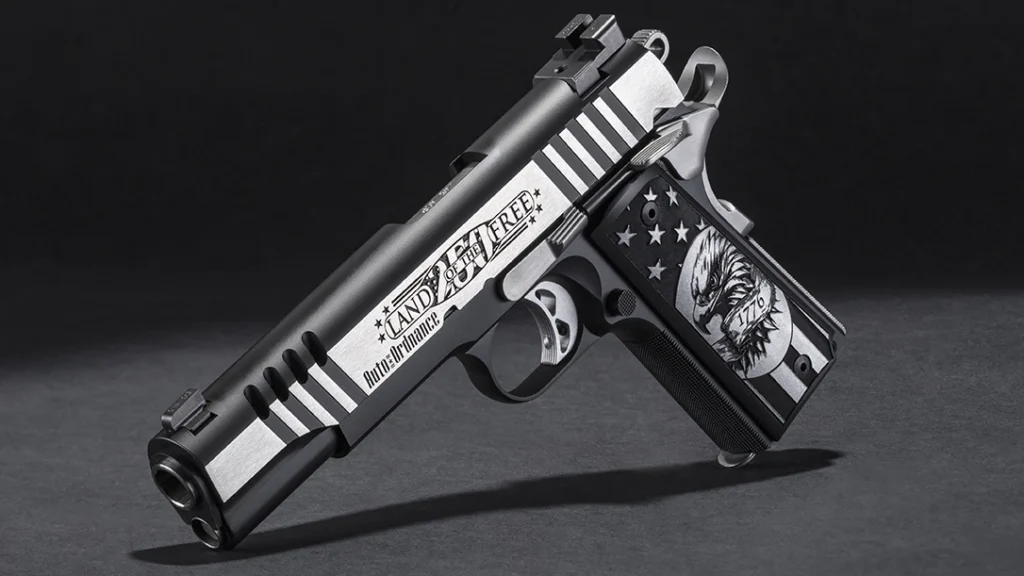
Auto-Ordnance’s decision to etch the “Land of the Free” 1911 with 250 years of independence imagery isn’t just marketing—it’s a deliberate reminder that the pistol John Moses Browning gave us in 1911 has outlasted every attempt to disarm the citizenry that carries it. The gun’s engravings may celebrate the Revolution, but its very existence celebrates something more immediate: the unbroken legal thread that still lets an American buy a newly manufactured 1911 in 2025 without a federal registry or prior restraint. That continuity matters when every election cycle brings fresh proposals to treat the same platform as a “weapon of war” that must be banned or neutered with magazine limits and feature bans.
By dressing a service-grade 1911 in patriotic scrollwork, Auto-Ordnance is also underscoring the commercial resilience of the 1911 platform itself. While polymer striker-fired pistols dominate duty holsters, the single-action .45 refuses to fade; its aftermarket ecosystem, parts availability, and cultural cachet keep it relevant even as polymer pistols multiply. The commemorative model therefore functions as both a collector piece and a quiet rebuttal to the narrative that only “modern” firearms deserve constitutional protection—proof that an all-metal, hammer-fired design born before the NFA is still being improved, sold, and defended under the same Second Amendment that shielded muskets in 1791.
For the 2A community the larger implication is straightforward: every time a manufacturer ships a limited-edition firearm that explicitly nods to the founding, it normalizes the idea that gun ownership is not an eccentric hobby but a living extension of the Republic’s origin story. That normalization matters in courtrooms and statehouses where judges and legislators are being asked to decide whether the right to keep and bear arms is a relic or a renewable license. The “Land of the Free” 1911 won’t swing those debates by itself, but it adds another data point that the right to arms is exercised daily by people who also wave the flag—an argument no amicus brief can fully replace.


