

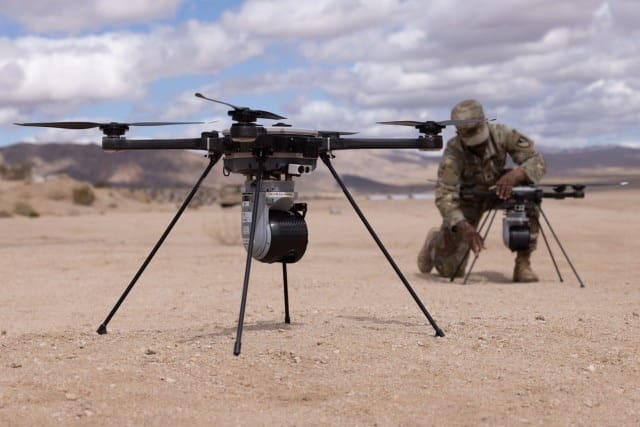
The Army’s decision to push Project Convergence-Capstone 6 into the brutal realism of Fort Irwin’s National Training Center isn’t just another exercise—it’s a live-fire stress test of the very systems that will decide whether tomorrow’s battlefield still belongs to the rifleman or to the algorithm. By expanding the scale and complexity of networked targeting, autonomous resupply, and AI-driven fires, the service is essentially rehearsing how a future force will decide who lives and dies faster than the enemy. For Second Amendment advocates, the takeaway is blunt: the same technologies that let a squad leader call precision munitions from a drone swarm can also be turned inward to monitor, restrict, or even disable privately owned firearms through digital kill-switches, geofencing, or centralized command authority. The experiment therefore doubles as a warning shot across the bow of civilian gun culture—master these tools or watch them master you.
What makes PC-C6 especially relevant is its timing. While the Army experiments with “converging” sensors, shooters, and sustainment across vast distances, state legislatures and federal agencies are simultaneously debating smart-gun mandates, micro-stamping, and ammunition serialization that would require the same kind of always-on data links the service is perfecting at Irwin. The 2A community has long argued that rights don’t depend on technological progress, yet the pace of military modernization shows how quickly the infrastructure for control can be built once the justification of “national security” is accepted. If the Army can track and neutralize threats across an entire division in minutes, the same architecture could, with only minor policy tweaks, track and neutralize a privately owned AR-15 the moment it leaves an approved GPS polygon. The lesson isn’t paranoia; it’s preparation—insist on air-gapped, non-networked firearms and mechanical safeties that cannot be overridden by firmware updates or executive orders.
Ultimately, Capstone 6 reminds us that the rifle remains the last physical veto against centralized power, but only if its owners refuse to trade that veto for convenience or connectivity. Every new data pipe the Army installs between shooter and sensor is another potential lever future administrations could pull against law-abiding citizens. The pro-2A response should therefore be twofold: support the warfighter’s need for decisive overmatch while drawing an uncompromising line against any technology that could be repurposed to disarm or monitor the very people the Constitution exists to protect.


