

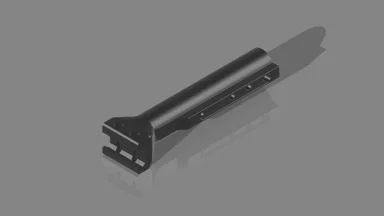
The AR-15 buffer tube has long been the default mounting point for adjustable stocks, but the Picatinny rail has become the universal language of the modern rifle. This adapter bridges those two worlds with a minimalist footprint—six walls of perimeter, 100 % infill, and a pair of M5 fasteners—turning any Picatinny surface into a buffer-tube host. In practice, it lets builders park a carbine stock on a chassis, a handguard top rail, or even the side of a receiver extension where traditional castle-nut geometry won’t reach. That flexibility is more than a convenience; it’s a quiet rebuke to the notion that the AR platform must remain frozen in its original configuration.
For the 2A community, the real story isn’t the adapter itself but the design philosophy it represents. Makers are no longer waiting for legacy manufacturers to green-light new stock interfaces; they’re iterating in public, sharing STL files, and letting end-users decide what counts as “standard.” The result is a living ecosystem where a brace ban, a feature restriction, or a state-level configuration rule can be met with an afternoon redesign rather than a trip to a gunsmith. In that sense, the little Picatinny-to-buffer-tube wedge is both tool and symbol: proof that the right to keep and bear arms now includes the right to remix the very furniture those arms wear.


