

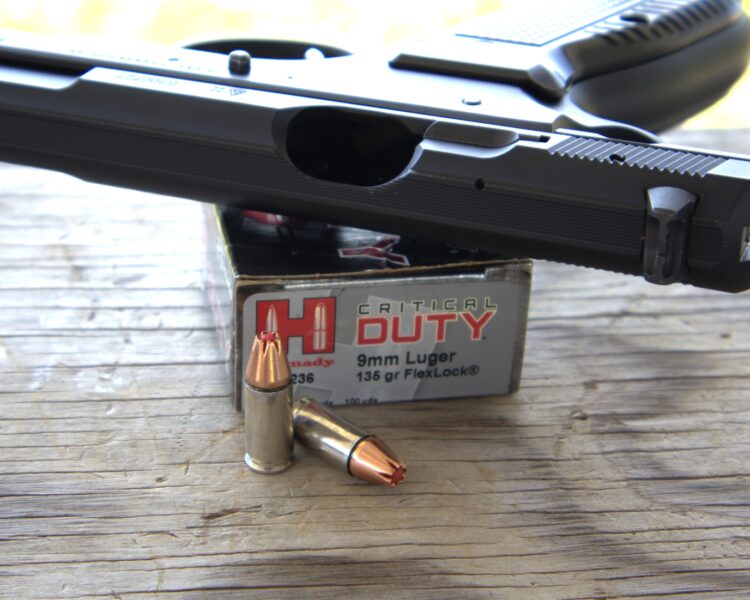
The Hornady Critical Duty 135-grain FlexLock has quietly become one of the more interesting duty loads to watch because it was engineered from the ground up to solve the FBI’s post-1986 penetration and barrier problems without the over-penetration headaches that plague many +P options. Where older bonded bullets often traded expansion for weight retention, the FlexLock’s elastomer-tipped, mechanically locked design keeps the core and jacket together even after punching auto glass or heavy clothing, yet still mushrooms to roughly 0.60–0.65 inches in bare gel—numbers that put it squarely in the FBI’s preferred window while staying inside the 12-to-18-inch penetration corridor. For the 2A community that argument matters: it shows private citizens can now buy factory ammunition that meets or exceeds the terminal-performance standards once reserved for federal agencies, narrowing the capability gap between what an armed citizen and a patrol officer can carry.
That performance also carries political weight. Every time a major manufacturer invests serious R&D money in a round optimized for defensive use rather than range plinking, it underscores that millions of lawfully armed Americans are a legitimate, growing market rather than an afterthought. The FlexLock’s street credentials—already adopted by several large departments—make it harder for anti-gun voices to paint modern hollow points as “exotic cop-killer” ammo when the same bullet is issued to the very officers those voices claim to support. In short, Hornady’s willingness to publish detailed barrier and gel data isn’t just good marketing; it’s quiet but effective push-back against the narrative that civilian self-defense ammunition is somehow suspect.
Finally, the round’s real-world implications extend beyond the gun counter. Because it runs reliably in compact 9mm platforms without the heavy recoil of some +P loads, it lowers the barrier for smaller-statured or recoil-sensitive carriers who still want duty-grade terminal performance. That accessibility matters in a political climate where training and readiness are under constant attack; the more shooters can afford and comfortably shoot quality defensive ammo, the larger and more skilled the pool of responsibly armed citizens becomes. In that sense, a single 135-grain bullet isn’t just ballistics data—it’s another incremental victory for the idea that an informed, equipped populace remains the ultimate check on both crime and creeping disarmament.


