

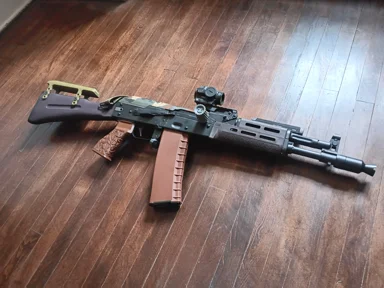
The AK100 stock cheek riser from MostlyPeacefulMachineShop represents a quiet but meaningful evolution in how the 2A community is approaching the customization of legacy platforms. Rather than chasing flashy aesthetics, this design zeroes in on the practical ergonomics of the AK platform—specifically the often-overlooked cheek weld that can make or break accuracy during extended range sessions or defensive use. By offering a 3D-printable solution that slots into the existing AK100 stock architecture, the creator is acknowledging that many shooters want to refine their rifles without waiting for big manufacturers to catch up or without navigating the patchwork of state-level restrictions on aftermarket parts.
What makes this release particularly noteworthy is the deliberate legal framing that accompanies it. The compliance statement is not boilerplate; it’s a clear signal that the designer understands the current climate where even innocuous accessories can draw scrutiny depending on jurisdiction. By explicitly carving out California and other restrictive states, MostlyPeacefulMachineShop is modeling a responsible approach that protects both the creator and the end user. This kind of transparency helps normalize the idea that lawful, personal manufacturing of firearm components is a legitimate exercise of Second Amendment rights rather than some shadowy workaround.
For the broader community, files like this underscore a growing reality: the future of firearms innovation is increasingly distributed, iterative, and user-driven. Instead of relying solely on large manufacturers or imported parts that may carry their own regulatory baggage, individuals are now empowered to solve small but meaningful problems—like improving cheek weld—on their own terms. That shift doesn’t just expand options; it reinforces the principle that the right to keep and bear arms includes the right to maintain, repair, and improve those arms without undue interference.


