

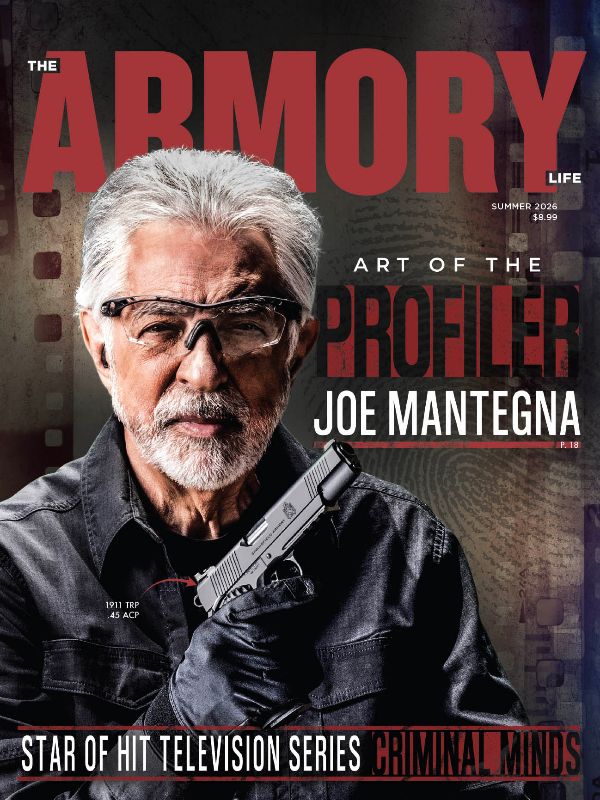
Joe Mantegna’s decision to grace the cover of The Armory Life’s Summer 2026 issue is more than celebrity casting—it’s a deliberate reminder that the Second Amendment’s coalition stretches far beyond the usual suspects. The actor’s long-standing support for lawful carry and his documented range time with Springfield Armory platforms give the quarterly’s 96 pages an unmistakable cultural reach, turning what could have been another gear-and-review spread into a conversation starter for fence-sitters who still equate gun ownership with fringe politics. When a recognizable face from network television frames the right to keep and bear arms as ordinary American recreation rather than partisan theater, the message lands in living rooms that might otherwise tune out traditional pro-2A messaging.
Inside those same pages, Capt. Dale Dye’s World War I retrospective quietly underscores why the right to arms has always been tethered to civic responsibility rather than hobbyist nostalgia. By juxtaposing period-correct trench rifles with modern Springfield offerings, the magazine invites readers to see continuity instead of rupture: the same principles that armed citizen-soldiers in 1918 underwrite the defensive utility of today’s striker-fired pistols and MSR platforms. That historical through-line matters at a moment when state-level restrictions are increasingly sold as “reasonable updates” to an 18th-century text; Dye’s essay functions as living proof that an armed populace has shouldered the nation’s defense long before the administrative state existed to regulate it.
For the broader 2A community, the issue’s timing is strategic. With election cycles and court dockets poised to test the Bruen standard yet again, cultural ambassadors like Mantegna expand the Overton window faster than another amicus brief. The Armory Life is betting that glossy storytelling—anchored by recognizable names and rigorous historical context—will keep new shooters inside the tent when the next round of magazine bans or “ghost gun” rules surfaces. In an era when legacy media still defaults to treating gun owners as an exotic subculture, a single cover can function as quiet but effective counter-programming.


