

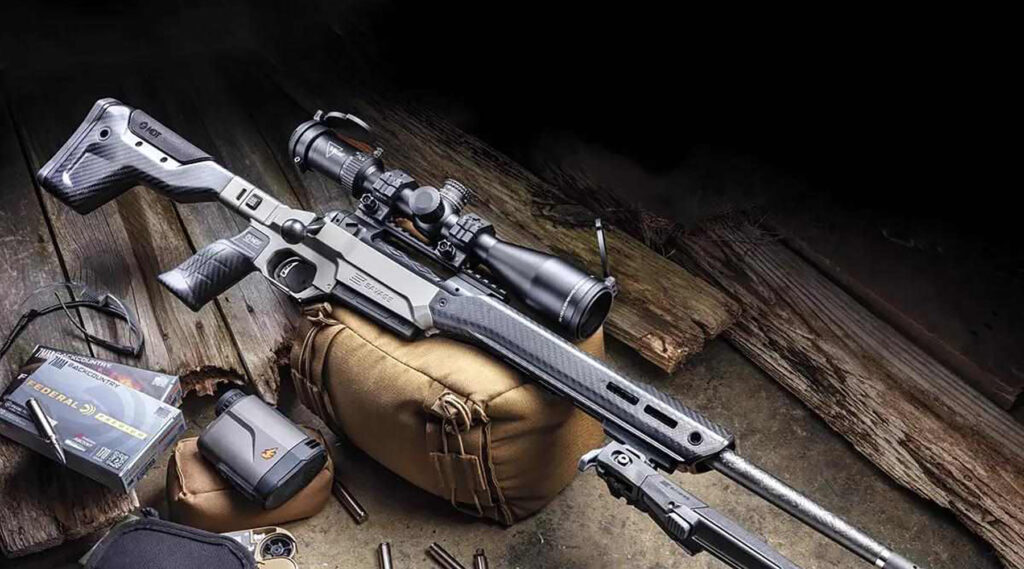
The Savage 110 Ultralite Elite isn’t just another lightweight hunting rifle—it’s a direct rebuke to the notion that serious long-range performance must come at the cost of portability or require a months-long custom build. By marrying Savage’s blueprinted 110 action with a Proof Research carbon-fiber barrel and MDT’s magnesium-and-carbon HNT26 folding chassis, the rifle delivers sub-half-MOA accuracy at just over six pounds while chambering the new 7mm Backcountry cartridge that pushes 170-grain bullets near 3,000 fps from an 18-inch tube. That combination matters because it proves factory rifles can now match the ballistic envelope once reserved for custom magnum builds, giving everyday hunters the same flat-trajectory, high-energy capability without surrendering the Second Amendment principle that lawful citizens should have ready access to top-tier defensive and sporting tools.
What makes this package especially relevant to the 2A community is how it sidesteps the regulatory and supply-chain bottlenecks that often throttle access to high-performance firearms. The 80,000-psi 7mm Backcountry round, enabled by Federal’s Peak Alloy case, achieves magnum-class ballistics in a short-action platform that remains legal in every state that permits centerfire rifles—unlike some traditional magnums that trigger extra scrutiny or outright bans in certain jurisdictions. When a production rifle can deliver that level of terminal performance with an adjustable, M-LOK-ready chassis and a 1.5-pound trigger, it undercuts the tired argument that only government-approved “sporting” configurations deserve to exist. Instead, it reinforces the practical case for an armed citizenry equipped with accurate, reliable, and portable firearms that can serve both backcountry pursuits and home-defense roles.
For pro-2A advocates, the Ultralite Elite also highlights why innovation flourishes when manufacturers are free to experiment without the chilling effect of ever-expanding restrictions. Savage didn’t need to wait for new legislation or special permits; it simply engineered a better mousetrap and let the market decide. That freedom to iterate—pairing carbon-fiber barrels, high-pressure cartridges, and modular chassis—keeps the firearms industry responsive to real-world needs rather than bureaucratic checkboxes. In an era when some lawmakers still push to limit magazine capacity, barrel length, or even the materials used in stocks, rifles like this stand as tangible proof that the right to keep and bear arms includes the right to own the most effective, modern tools available.


