

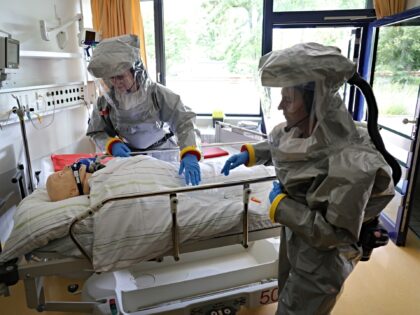
The World Health Organization’s call for volunteers to test experimental Ebola vaccines in the middle of the deadliest recorded outbreak in the Democratic Republic of the Congo is a stark reminder that governments and global bureaucracies are often the last to arrive with solutions—and the first to ask citizens to shoulder the risk. While the agency touts trials in Canada and the UK, the real story is the DRC’s inability to contain the virus amid chronic instability, corruption, and the collapse of basic infrastructure. For the 2A community, this is not an abstract public-health footnote; it is a case study in what happens when a population cannot rely on the state for protection—whether from armed militias or from a Level-4 pathogen that spreads faster than any government response team can track.
History shows that disease outbreaks and civil disorder travel together. In places where citizens have been disarmed by edict or culture, the vacuum is filled by whoever has the remaining guns—rebel groups, bandits, or even the occasional armed NGO convoy. The DRC’s long-running insurgencies have already turned hospitals into targets and forced health workers to negotiate with warlords for safe passage. An armed, trained citizenry cannot cure Ebola, but it can secure perimeters, escort medical teams, and prevent the kind of looting that turns treatment centers into vector incubators. The same principle applies at home: when panic hits, the first thing stripped from store shelves is not hand sanitizer—it is ammunition. Communities that have spent decades cultivating marksmanship, logistics, and mutual-aid networks will be far better positioned to impose the cordon sanitaire that slow-moving bureaucracies cannot.
The deeper implication is philosophical. The WHO’s plea for “volunteers” masks a quiet admission that centralized planning fails at the edge of chaos. Rights-based self-defense is not a cultural quirk; it is the distributed immune system of a free society. Whether the threat is a hemorrhagic fever or a mob exploiting the fever to settle scores, the lesson is identical: waiting for permission to act is a luxury that collapses the moment the outbreak—or the riot—crosses the next ridgeline. The 2A community’s long-standing emphasis on individual preparedness, decentralized logistics, and the moral legitimacy of armed self-reliance is not paranoia; it is the only scalable response when the map no longer matches the territory.


