

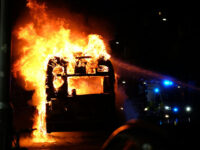
A teenager in Canada has been charged after allegedly setting fire to a minor league baseball team’s bus, an act that instantly raises eyebrows for anyone tracking how property crimes and public safety intersect with the right to keep and bear arms. While the incident itself is a straightforward case of arson, the broader pattern is familiar: when law-abiding citizens are stripped of effective means of self-defense, opportunistic criminals—often young and emboldened—feel freer to target high-value, lightly guarded assets like team buses, equipment trailers, and parked vehicles. Canada’s already restrictive firearms laws did nothing to deter this act of destruction; they merely ensured that bystanders or team staff had no legal way to intervene with a firearm if the situation had escalated to violence against people rather than property.
The implications for the 2A community south of the border are clear. This episode underscores why American gun owners continue to resist “common-sense” restrictions that mirror Canada’s model: once a society normalizes the idea that only the government or licensed security can possess tools of force, ordinary citizens become spectators to crimes they are powerless to stop in real time. Minor league teams operate on thin margins; replacing a torched bus can run into six figures, and insurance premiums climb when theft and arson become recurring line items. Those costs ultimately get passed to fans and players, illustrating how anti-gun policies don’t just disarm individuals—they quietly raise the price of everyday life for entire communities.
For Second Amendment advocates, the takeaway is not that every baseball fan should pack heat at the stadium, but that the philosophical foundation of the right to bear arms remains sound: an armed citizenry creates friction against lawlessness that paper laws alone cannot provide. Canada’s teen arsonist will face charges, yet the larger cultural message is already written—the absence of defensive firearms did not prevent the crime, and the presence of armed, responsible citizens in similar American settings continues to serve as the quiet deterrent that progressive gun-control experiments have yet to replicate.


