

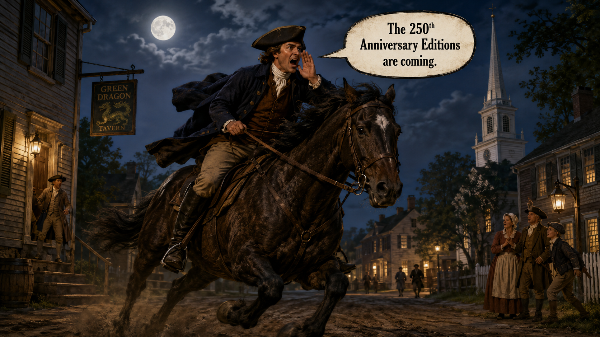
Sam Colt’s fingerprints are all over the American experiment, and as the nation marks its 250th birthday the timing feels almost poetic. The revolver he perfected didn’t just arm frontiersmen; it gave ordinary citizens a practical means to project power equal to that of any standing army or well-armed bandit. In an era when the Founders’ vision of an armed populace was still being tested on the edges of settlement, Colt’s interchangeable parts and assembly-line methods turned the right to keep and bear arms from an abstract principle into hardware that could be carried daily. That shift helped cement the cultural expectation—still fiercely defended today—that self-reliance is not a privilege granted by government but a birthright secured by technology and tradition.
For the 2A community the milestone is less about nostalgia and more about continuity. Colt’s innovations lowered the cost and raised the reliability of personal arms at precisely the moment westward expansion and urban growth demanded them, proving that technological progress and individual liberty can reinforce each other. Modern infringements—magazine bans, “assault weapon” restrictions, registration schemes—echo the same logic 19th-century monopolists used to argue that only the state or licensed elites should possess rapid-fire arms. Celebrating Colt’s legacy therefore doubles as a reminder that every restriction on today’s equivalents is an attempt to roll back the very democratization of force he helped engineer.
Looking ahead, the lesson is straightforward: the right to arms is only as robust as the tools and the culture that sustain it. As the semiautomatic age gives way to smart guns, 3-D printing, and digital encryption debates, the community that remembers Colt’s role in making firepower accessible will be best positioned to insist that new technologies serve liberty rather than become new gatekeepers. The 250th is an occasion to honor that lineage, not as relic worship but as strategic memory—proof that when citizens control the means of their own defense, the republic remains harder to disarm than its would-be rulers ever expect.


