

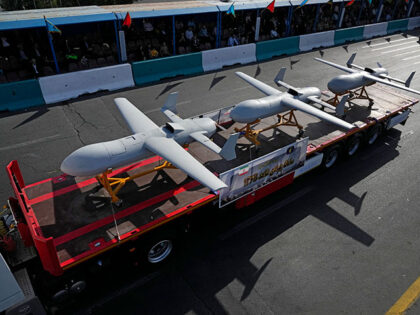
The downed F-15 pilot’s account of a synchronized “jellyfish” drone swarm isn’t just another war story—it’s a live demonstration of how cheap, attritable unmanned systems can overwhelm even the most sophisticated Western fighters. Iran’s ability to coordinate dozens of small drones into a single, fluid formation that masks individual radar returns and saturates defensive sensors should alarm anyone who still believes air superiority is guaranteed by platform cost or pilot skill. For the Second Amendment community, the lesson is straightforward: when nation-states prove they can field massed, low-cost aerial threats that legacy fighters struggle to defeat, the same logic applies at home—citizens need access to the tools and training that let individuals or small teams counter drone swarms, whether that means legal semi-automatic rifles with modern optics, suppressors for follow-up shots, or the freedom to experiment with legal counter-UAS tech without being treated as potential terrorists.
What makes this incident especially relevant is the speed at which the technology is proliferating. The same commercial components and open-source flight-control software that let hobbyists build FPV drones are being weaponized by state actors and non-state groups alike; if Tehran can field a jellyfish formation today, tomorrow’s cartel or terrorist cell could replicate a smaller version over U.S. soil. That reality undercuts the tired argument that “assault weapons” are only good for fighting the last war. In an era where the next conflict may open with drone clouds rather than tank columns, the ability of an armed citizen to engage multiple fast-moving aerial targets at practical ranges becomes a legitimate national-security consideration, not a fringe talking point. Lawmakers who continue to push magazine bans and feature restrictions are effectively telling Americans they cannot prepare for the very threats our own military is now studying in after-action reports.
The pilot’s survival and rescue also highlight how quickly the battlespace can shift from manned to unmanned dominance. Once the F-15’s radar and missiles were saturated, the outcome hinged on special-operations extraction rather than airpower alone—an expensive, high-risk proposition that won’t scale if dozens of jets are lost in the first hours of a peer conflict. For 2A advocates, the takeaway is that rights are exercised in the context of real capability, not theory. If the government’s own after-action reviews are now treating massed drone attacks as a baseline threat, then restricting the very firearms and accessories that give private citizens a fighting chance against similar low-cost aerial harassment is not prudent policy; it’s unilateral disarmament in the face of demonstrated technology.


