

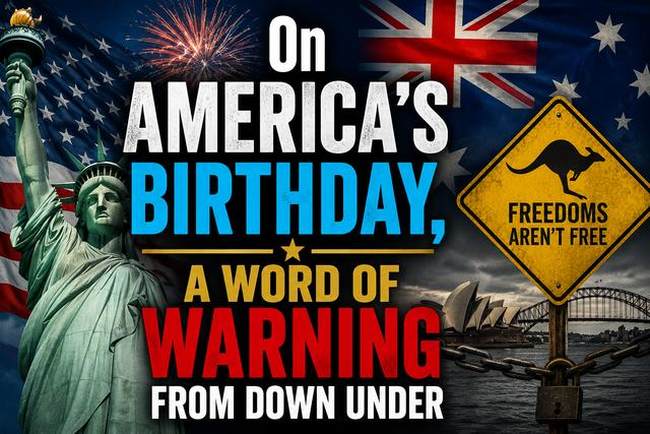
On America’s birthday, the contrast between two nations’ approaches to self-defense couldn’t be sharper, and Topher Field’s timely appearance with Cam Field drives that point home with the kind of clarity only an outsider can deliver. While July 4th fireworks lit up U.S. skies, Field reminded listeners that America’s unique constitutional architecture—rooted in the explicit recognition that the right to keep and bear arms predates government—remains the global exception rather than the rule. The recent Australian self-defense shooting he’s highlighting isn’t just another news item; it’s a crack in the long-standing narrative that has painted civilian firearm ownership as inherently dangerous, forcing even Australia’s tightly controlled debate to confront the uncomfortable reality that law-abiding citizens sometimes need tools to protect themselves when seconds count and police are minutes away.
What makes Field’s commentary particularly potent for the 2A community is how it exposes the downstream effects of Australia’s 1996 buyback and subsequent restrictions: a cultural conditioning that treats armed self-defense as morally suspect rather than a natural right. The fact that one defensive shooting is now shifting that conversation suggests the prohibitionist model may be reaching its rhetorical limits, especially as crime patterns and public safety concerns evolve. For American gun owners watching from across the Pacific, this serves as both validation and warning—validation that constitutional carry and shall-issue permitting reflect a more realistic assessment of human nature and government limitations, and warning that the same incremental arguments about reasonable restrictions that disarmed Australia are still being tested in statehouses and courtrooms here at home.
The deeper implication is that America’s firearm freedom isn’t merely a policy preference; it’s a structural safeguard that preserves the individual agency other Western democracies surrendered decades ago. Field’s outsider perspective underscores how rare and fragile that arrangement remains, and how quickly cultural memory of self-reliance can fade when the state monopolizes defensive force. As the 2A community continues defending that inheritance against regulatory creep, stories like Australia’s emerging debate offer both cautionary precedent and renewed appreciation for the constitutional firewall that still separates American gun owners from the disarmed dependency model that much of the English-speaking world accepted without serious pushback.


