

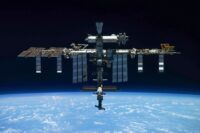
While the world watched astronauts huddle in the Russian segment of the ISS as a coolant leak threatened their habitat, the episode quietly underscored a truth the 2A community has long understood: when you’re millions of miles from help, the only reliable safety system is the one you brought with you. The crew’s decision to shelter in place wasn’t born of panic but of preparation—sealing hatches, running checklists, and relying on redundant systems designed, tested, and trusted long before the leak appeared. That same mindset—anticipating failure, training for it, and carrying the tools to survive it—mirrors why millions of Americans keep firearms ready rather than hoping someone else will arrive in time.
The leak itself, traced to a radiator line on the Nauka module, was patched with a combination of clamps and sealant applied during a spacewalk that had already been scrubbed once for weather. NASA and Roscosmos treated the event as routine risk management, not an existential crisis, precisely because decades of engineering had already baked in margins for error. For gun owners, the parallel is obvious: just as orbital hardware is only as good as the foresight that went into it, a defensive firearm is only useful if it was chosen, maintained, and trained with before the moment of need. The astronauts didn’t debate the Second Amendment in orbit; they simply lived its underlying principle that self-reliance beats waiting for rescue.
Critics who claim “no one needs” a defensive tool in space—or on Earth—ignore the same data that keeps ISS crews alive: redundancy works. Every extra minute the astronauts spent behind closed hatches was time bought by prior preparation, not by last-minute improvisation. That lesson travels straight back to terrestrial debates over magazine capacity, training requirements, and the right to keep arms accessible. When systems fail at 250 miles up or on a quiet suburban street, the margin between problem and catastrophe is measured in seconds and in the equipment already in hand.


