

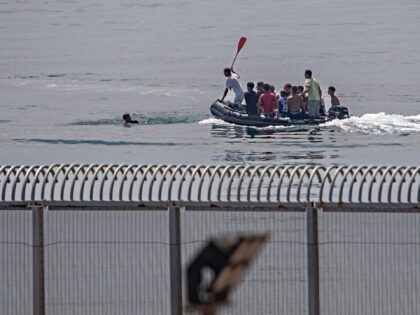
Spain’s Supreme Court just handed the country’s border a legal straitjacket, and the result is already visible in the surf off Ceuta: more than a thousand migrants swimming ashore because the government can no longer turn back small boats at sea. The ruling, framed as a humanitarian safeguard, effectively converts the Mediterranean into a one-way ferry lane for anyone willing to risk the water. What looks like a narrow procedural decision is, in practice, a standing invitation that overwhelms local resources and leaves Spanish citizens wondering who, if anyone, is still in charge of the nation’s perimeter.
For the 2A community the lesson is immediate and sobering. When a sovereign state voluntarily strips itself of the most basic tool of self-preservation—physical control of its own shoreline—it creates the precise conditions that make an armed citizenry indispensable. Spain’s experiment shows how quickly progressive legal theories can disarm a nation long before any gun is touched; the same philosophy, applied in the United States, would leave law-abiding Americans to fill the security vacuum with their own rifles and training. The right to keep and bear arms is not an abstract tradition; it is the last functional backstop when institutions decide that borders are optional and consequences are somebody else’s problem.
The Ceuta footage should be studied in every gun-club classroom. It is a live demonstration that paper guarantees are only as strong as the will to enforce them, and that an armed populace is the final insurance policy against policies that treat national territory as a theoretical construct rather than a physical reality.


