

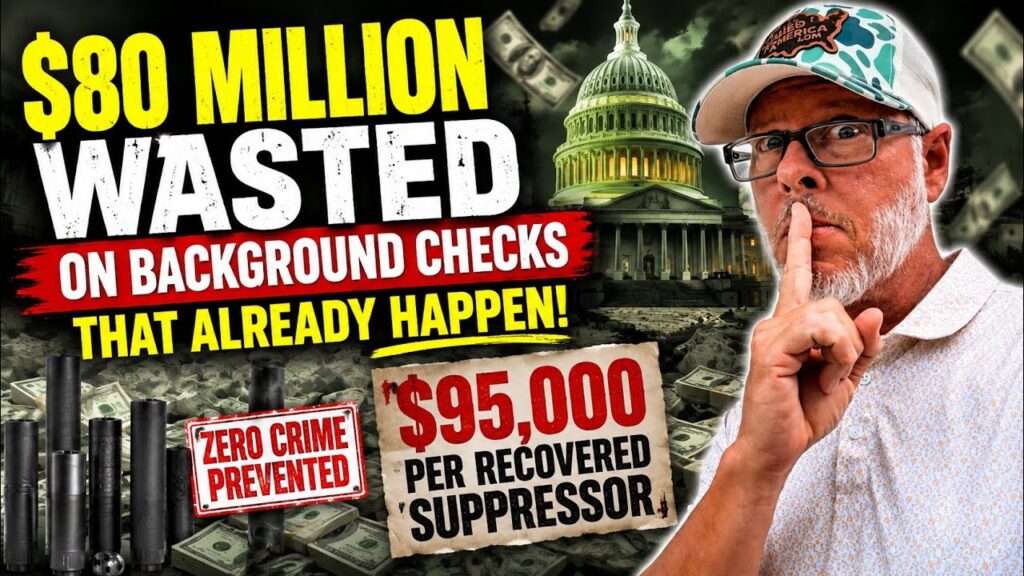
The federal government’s $80 million annual outlay for the National Firearms Act registry is the bureaucratic equivalent of buying a $95,000 GPS tracker for a single suppressor that already carries a $200 tax stamp and a months-long waiting period. Every Form 4, every fingerprint card, every CLEO notification is processed, scanned, and stored in a system whose sole purpose is to let ATF agents trace an item that, by definition, only law-abiding citizens bother to register. That price tag works out to roughly $1,200 per currently registered NFA item—an astonishing premium when you consider that the overwhelming majority of these firearms and accessories will never be used in a crime. The real-world payoff is a paper trail that rarely solves cases but reliably chills lawful ownership.
For the 2A community, the numbers expose a deeper truth: registration is not a neutral administrative function; it is a costly deterrent dressed up as public safety. Lawmakers who claim “universal background checks save lives” rarely mention that the same infrastructure already exists for NFA items and still consumes eight figures a year with negligible investigative return. The expense also underscores why any new national registry—whether for pistols, semiautos, or magazines—would instantly balloon into another fiscal sinkhole while doing nothing to disarm criminals who ignore paperwork. Instead of funding faster trace responses or targeting actual traffickers, Congress keeps feeding a clerical machine whose chief product is a permanent list of names.
The lesson is straightforward: every dollar spent perfecting the registry is a dollar not spent on prosecuting violent offenders or securing the border. Until the 2A community forces a reckoning with these costs, the $95,000-per-item math will keep climbing, one suppressed SBR at a time.


