

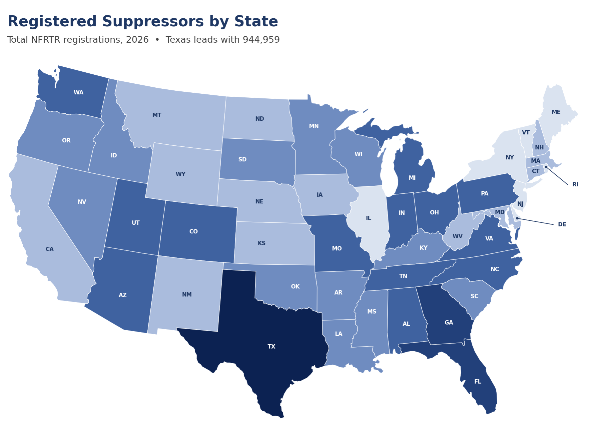
The data from the ATF’s National Firearms Registration and Transfer Record paints a fascinating picture of suppressor ownership across the country, and it’s one that challenges the old narrative that “silencers” are rare, exotic items reserved for a tiny elite. States like Texas, Pennsylvania, and Utah top the charts not simply because of population size, but because they’ve embraced shall-issue trust and individual paperwork processes that treat suppressors as the hearing-protection and neighbor-friendly tools they are. Meanwhile, California and New York—despite massive populations—lag far behind, a direct result of discretionary “may-issue” policies, seven-to-twelve-month wait times, and a political climate that still pretends these devices are more dangerous than the firearms they’re attached to. The caliber split is equally telling: .22 LR and .223/5.56 dominate the registry, underscoring that the everyday plinker and the home-defense AR owner are driving this growth, not some shadowy special-operations fantasy.
What the numbers really expose is a slow-motion policy victory for the pro-2A community. Thirty-nine states now allow civilian ownership, and the steady climb in Form 4 approvals shows that millions of Americans are willing to jump through the $200 tax-stamp hoop when the alternative is continued hearing damage and noise complaints. The data also hints at an emerging rural-versus-urban divide that gun owners instinctively understand: in states where land is plentiful and neighbors are distant, suppressors are practical accessories; in dense, anti-gun jurisdictions, they remain political symbols rather than tools. That divide will only sharpen as more legislatures move to abolish the state-level stamp or waiting period, effectively daring the next Congress to zero-out the federal tax as well.
For the broader Second Amendment movement, these figures are both validation and a roadmap. They prove that when the paperwork burden is predictable and the political climate is neutral-to-friendly, lawful citizens will register in large numbers—undercutting the “only criminals want silencers” trope with hard data. They also flag the next pressure points: pushing remaining may-issue states toward constitutional carry-style reforms for NFA items, and preparing for the inevitable court challenges once a few more legislatures zero-out their own taxes. In short, the cans are where the culture of lawful, responsible gun ownership is already winning; the question is how fast the rest of the map catches up.


