

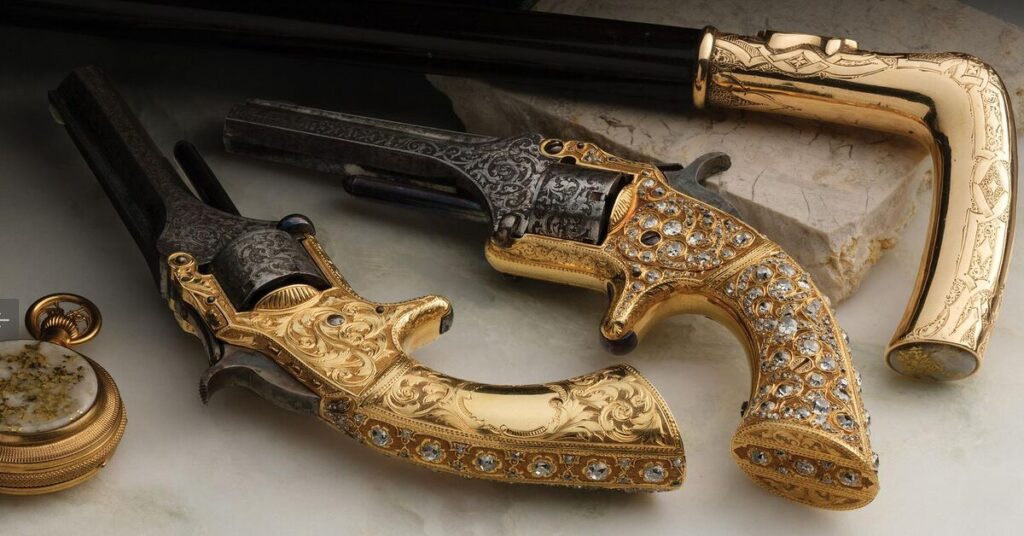
The Rock Island Auction listing of a pair of diamond-encrusted, gold-plated Smith & Wesson No. 1 revolvers isn’t just another high-dollar lot—it’s a reminder that the Second Amendment protects the right to keep and bear arms without a government-imposed dress code. These Victorian-era pocket revolvers, originally chambered in .22 rimfire and carried by 19th-century travelers who valued discreet self-defense, have been transformed into literal jewelry. Their presence on the block next June tells us two things at once: first, that serious money still flows toward finely crafted American firearms even when they’re turned into objets d’art, and second, that the cultural value of a wheelgun can survive every attempt to turn it into something purely decorative. For the 2A community, the takeaway is straightforward—rights exercised by the wealthy set precedents that protect the working man’s carry piece; if the government can’t ban gold-plated diamonds, it certainly can’t ban plain stainless steel.
What makes the story richer is the contrast between these blinged-out relics and the everyday carry guns that millions of Americans rely on for the same fundamental purpose: lawful self-defense. The No. 1’s original owners didn’t buy them for status; they bought them because a compact revolver was often the only practical option when traveling through lawless territories. Today’s concealed-carry licensees carry modern J-frames and LCRs for exactly the same reason, only without the 24-karat distraction. When auction houses showcase such extreme custom work, they inadvertently highlight how durable the underlying right remains—private property in firearms, freely transferred, customized, and even encrusted with gems, all without prior restraint. That durability matters when legislation in various states tries to limit magazine capacity, cosmetic features, or the mere act of selling a used handgun; the existence of million-dollar variants proves the activity itself is ordinary commerce, not a loophole needing closure.
Finally, the pistols serve as a quiet rebuttal to the notion that firearms are only legitimate when they look “tactical” or only dangerous when they look “military.” A diamond-covered Smith & Wesson is still a Smith & Wesson, capable of chambering the same .22 Short cartridge that turned the original No. 1 into a pocket powerhouse. The 2A community should treat these auction spectacles as cultural capital: every time a six-figure revolver crosses the block, it reinforces that gun ownership spans every economic and aesthetic stratum. Whether you carry a bone-stock Model 642 or simply admire the craftsmanship of gold and gems, the principle is identical—the right to keep and bear arms belongs to the people, not to a government-approved color palette.


