

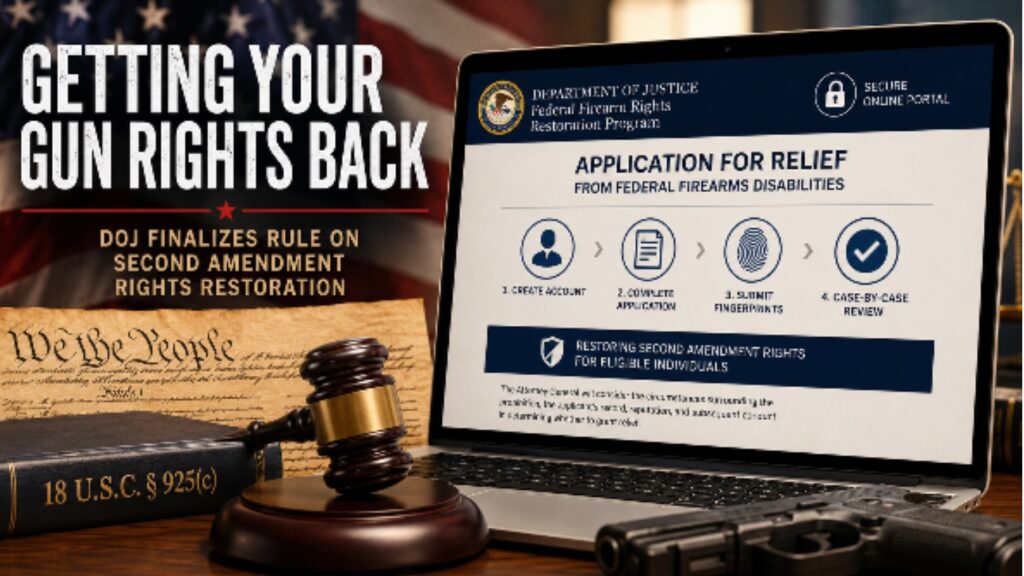
For more than three decades, the federal statute that lets the Attorney General restore firearm rights to certain prohibited persons has been little more than a dead letter—Congress even defunded the program in 1992. Now the Trump DOJ appears ready to dust it off, and the mechanics are straightforward: an individual files an application with ATF, the agency conducts a full background investigation, and the Attorney General (or his designee) grants relief if the applicant “will not be likely to act in a manner dangerous to public safety” and granting relief “would not be contrary to the public interest.” Because the process lives in the U.S. Code rather than in mere regulation, a future administration cannot simply wave it away; any denial would be subject to judicial review under the Administrative Procedure Act, giving successful litigants a powerful tool to force the agency’s hand.
That shift matters far beyond the handful of people who might regain their rights this year. It re-opens a conversation the gun-control lobby has spent a generation trying to shut down: that “prohibited person” is not a permanent, irrebuttable judgment but a fact-specific determination that can be revisited. If the restored-rights pipeline begins to move, expect lawsuits arguing that other lifetime bans—on non-violent felons, on certain misdemeanants, even on some veterans flagged by the VA—are likewise subject to individualized review under the Second Amendment and the Due Process Clause. The optics are equally potent; every restoration becomes a human-interest story that undercuts the narrative that anyone who ever brushes the criminal-justice system must be permanently disarmed.
For the broader 2A community, the development is both an opportunity and a warning. It is an opportunity to demonstrate that a functioning restoration process can be rigorous without being impossible, thereby blunting calls for ever-expanding prohibitions. It is a warning that the same statutory mechanism could be used by a future administration hostile to gun owners to create a slow, bureaucratic maze that looks fair on paper but denies relief in practice. The next twelve months will show whether the Trump DOJ treats the statute as a genuine avenue for relief or merely as a talking point; the difference will shape not only individual lives but the constitutional baseline for who may keep and bear arms in America.


