

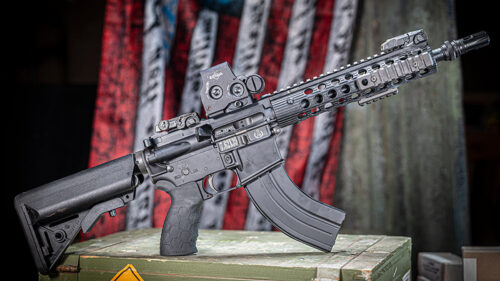
The Supreme Court’s docket is quietly filling with cases that could finally force a reckoning on the constitutionality of banning America’s most popular rifle platform, and the Second Amendment Foundation’s new petition in Calce v. City of New York is the latest reminder that the antis can’t keep kicking the can down the road. While lower courts have spent years inventing “sensitive places” and “sensitive times” to uphold restrictions, the plain text, history, and tradition test from Bruen leaves little room for treating a semiautomatic rifle as some exotic outlier rather than the modern continuation of arms “in common use” that Heller already protected. The uncomfortable truth for gun-control advocates is that every delay only sharpens the eventual collision: once the Court confronts the fact that millions of law-abiding citizens own AR-15s for lawful purposes, the legal architecture supporting feature bans and assault-weapon prohibitions starts to look more like policy preference than constitutional doctrine.
For the 2A community this development is both validation and a call to disciplined messaging. The SAF filing underscores that the fight isn’t just about one city’s rules; it’s about whether the judiciary will continue to treat the right to keep and bear arms as a second-class freedom subject to ever-shifting interest-balancing tests. If the Court grants cert, the resulting decision could sweep away not only New York’s restrictions but also the patchwork of state-level bans that have survived on the thinnest of historical analogies. That outcome would shift the Overton window dramatically, making future magazine-capacity limits and “ghost gun” rules the next targets rather than settled law. The antis know this, which is why their strategy has shifted from outright denial of the right’s existence to frantic efforts to redefine what counts as an “arm” or to manufacture new historical analogues that simply didn’t exist in 1791 or 1868.
The broader implication is that the cultural and political battle over semiautomatic rifles is entering its endgame at the highest court. Pro-Second Amendment advocates should treat every new petition not as an isolated skirmish but as cumulative pressure that makes eventual review more likely, not less. When the dust settles, the question won’t be whether AR-15s are protected; it will be how many other modern arms the Court is willing to place beyond the reach of legislative majorities. That clarity, once delivered, will reshape everything from litigation strategy to state-level legislation for a generation.


