

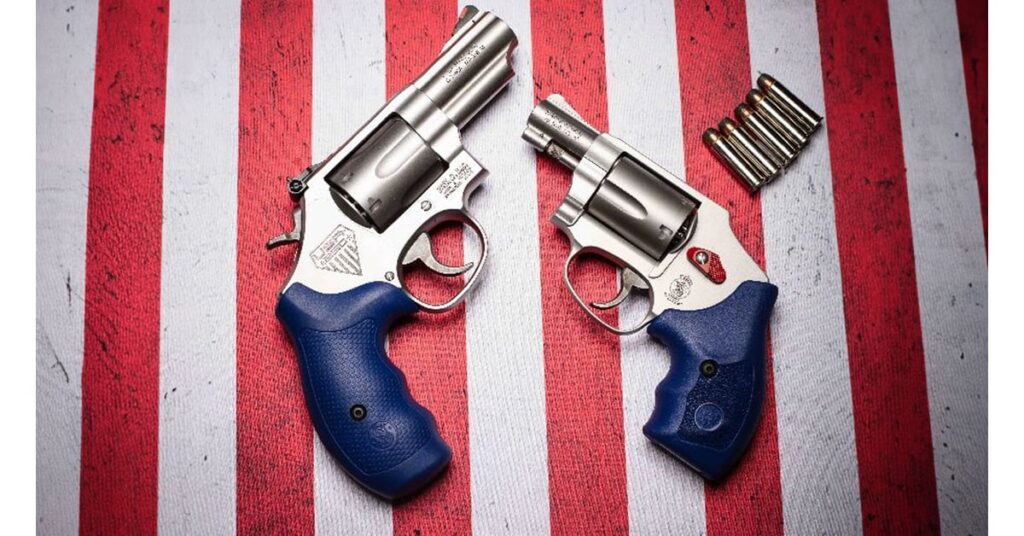
Smith & Wesson’s decision to wrap its iconic Model 642 and Model 66 in red-white-and-blue trim for the nation’s 250th anniversary is more than a marketing flourish—it’s a quiet reminder that the revolver remains the most durable symbol of American self-reliance. The 642, a lightweight .38 Special Airweight that has long served as the quintessential “pocket gun” for concealed-carry permit holders, now carries a laser-engraved 1776-2026 motif on its brushed-aluminum frame, while the stainless-steel 66 receives matching patriotic medallions and a custom serial-number range. Both guns are limited to 250 units apiece, a number that neatly mirrors the anniversary and guarantees instant collectibility.
For the 2A community, the timing is telling. As states continue to expand constitutional carry and the Supreme Court’s Bruen decision keeps reshaping lower-court precedent, these limited revolvers arrive as tangible artifacts of a culture that refuses to treat the Second Amendment as a relic. The 642’s continued relevance in an era of micro-compact 9 mm pistols underscores a deeper truth: wheelguns still offer simplicity, reliability, and the legal advantage of not being labeled “assault weapons” in restrictive jurisdictions. Meanwhile, the Model 66’s six-shot .357 platform remains a benchmark for home-defense versatility, its adjustable sights and full-lug barrel giving seasoned shooters a confidence few striker-fired pistols can match.
Beyond the aesthetics, the release quietly underscores Smith & Wesson’s own political evolution. After relocating its headquarters from Massachusetts to Tennessee in 2021, the company has leaned into Second Amendment advocacy with new vigor; these commemorative revolvers serve as both product launch and cultural statement. For enthusiasts, the real value may lie less in future appreciation than in the opportunity to own a numbered piece of Americana that celebrates where the right to keep and bear arms began—and signals where the industry intends to keep taking it.


