

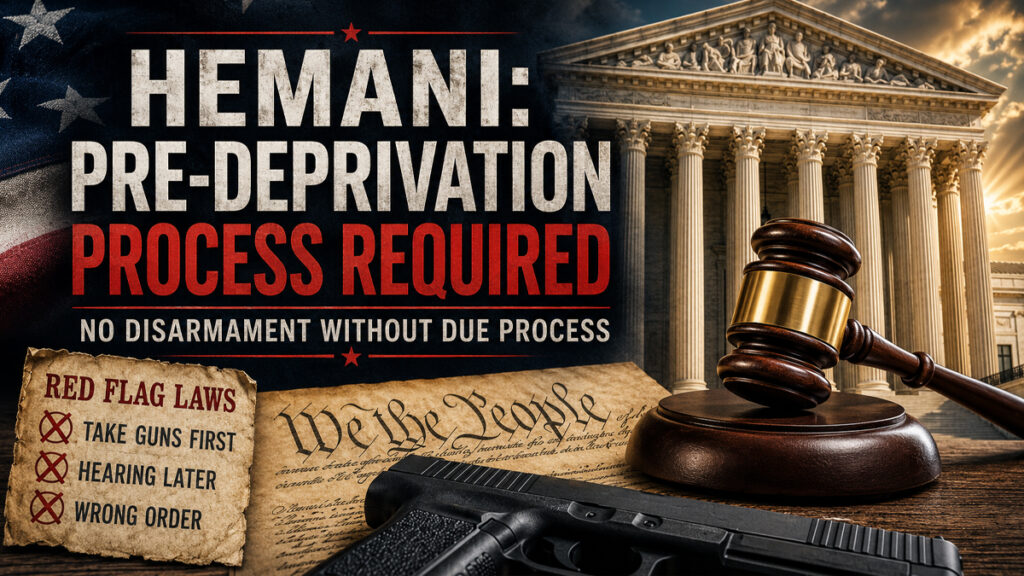
The Supreme Court’s Hemani decision lands like a precision shot across the bow of every red-flag regime that treats due process as an afterthought. By clarifying that the Second Amendment’s protections do not evaporate the moment a neighbor or ex-partner files an ex-parte petition, the Court has effectively told states they cannot outsource the deprivation of fundamental rights to civil courts operating on lowered standards and rubber-stamp hearings. For years, these laws have thrived in the gray zone between criminal accusation and civil restraint; Hemani slams that zone shut by insisting that any mechanism capable of stripping a citizen of the right to keep and bear arms must meet the same constitutional muster as any other prior restraint on enumerated rights.
What makes the ruling especially potent for the 2A community is the ripple effect it will have on pending litigation in states that built their red-flag statutes on the flimsiest procedural scaffolding. Expect defense attorneys to dust off facial and as-applied challenges that previously stalled in lower courts now armed with clearer Supreme Court language on notice, opportunity to be heard, and the government’s burden. The decision also hands state legislatures a stark choice: either retrofit their laws with genuine adversarial process and heightened evidentiary thresholds or watch them dismantled piece by piece in federal court. Gun owners who have lived under the constant threat of secret filings and one-sided affidavits now have a new precedent to cite when demanding their day in court before any firearm is seized.
Beyond the immediate legal victories, Hemani reframes the policy debate itself. Proponents of red-flag laws have long sold them as narrowly tailored public-safety tools; the ruling exposes how many of those tools were never narrow at all. Going forward, any jurisdiction that wants to keep such a system will have to defend it under strict scrutiny rather than the breezy rational-basis hand-waving that has carried the day in some circuits. That higher bar will force honest conversations about false-positive rates, due-process costs, and whether the marginal safety gain justifies the permanent infringement on an individual’s constitutional rights. For the broader Second Amendment community, the message is unmistakable: procedural shortcuts around the Bill of Rights have an expiration date, and that date just moved a lot closer.


