

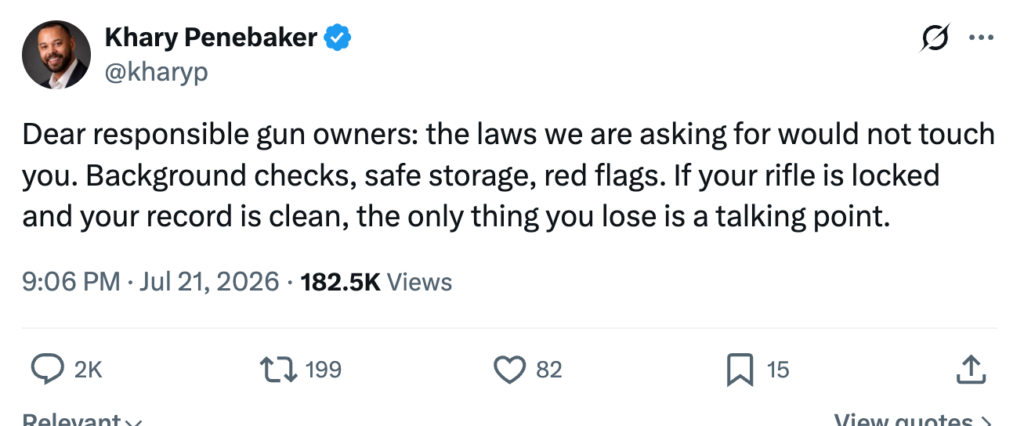
The “common-sense” label has always been a moving target, and the gun-owning public has watched it inch steadily leftward for decades. What began as background checks for retail sales has metastasized, in state after blue state, into registration schemes, magazine bans, “assault-weapon” prohibitions, and even restrictions on the number of handguns a law-abiding citizen may purchase in a month. Each new rule is sold as a modest, narrowly tailored step; each one, once enacted, becomes the baseline for the next demand. The result is a policy ratchet that never clicks backward, only forward, until the original right has been whittled down to a heavily regulated privilege.
That pattern is precisely why rank-and-file gun owners treat every new “commonsense” proposal as the leading edge of a larger project rather than an isolated reform. They have seen California’s handgun-roster system shrink to a handful of grandfathered models, New York’s SAFE Act turn millions of magazines into overnight contraband, and New Jersey’s carry-permit regime function as de-facto discretionary denial. These aren’t anomalies; they are the predictable outcome when legislators define “reasonable” as whatever the political climate will currently bear. Once that precedent is set, national-level proposals inherit the same expansive logic.
For the 2A community, the lesson is straightforward: legislative “half-measures” are rarely endpoints; they are benchmarks. The safest way to keep future restrictions from metastasizing is to refuse the first concession that rests on the assumption that rights must be justified rather than infringements. Every successful defense of an existing platform—whether it is standard-capacity magazines, semi-automatic rifles, or shall-issue carry—raises the cost of the next bite at the apple and keeps the slope from sliding any further.


