

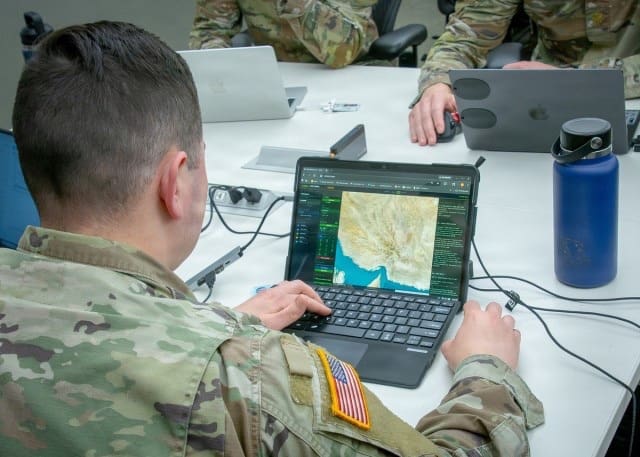
The Army’s decision to embed AI into the Command and General Staff College curriculum is less about replacing the rifleman and more about accelerating the feedback loop between shooter and system. By feeding real-time ballistic data, environmental variables, and shooter biometrics into the same loop that once relied on a spotter’s notebook, the service is essentially compressing years of field experience into weeks of simulation. For the 2A community, the takeaway is straightforward: the same sensor fusion and machine-learning techniques that let an AI “call the shot” can also be ported to civilian precision rifles, smart scopes, and hand-held ballistic computers. In other words, the Army is subsidizing the R&D that will eventually show up on store shelves as $1,500 thermal-etched reticles and Bluetooth-enabled chronographs.
That transfer matters because it flips the usual political script. Rather than waiting for commercial innovation to trickle down to the military, the Pentagon is now the lead investor in open-source datasets—wind modeling, sub-MOA group analytics, even shooter heart-rate variability—that any licensed civilian can access once the information is declassified or mirrored by private firms. The constitutional right to keep and bear arms has always included the right to keep and bear information about those arms; an AI that tells you exactly how your 6.5 Creedmoor will behave at 1,180 meters is simply the twenty-first-century equivalent of a Ballard rifleman’s hand-drawn dope card. The danger, of course, is mission creep: if the same algorithms are later used to log every round a civilian shooter fires, the 2A community will have to insist that data provenance and ownership remain with the individual, not the cloud provider or the state.
Ultimately, the Leavenworth initiative underscores a deeper truth about the Second Amendment in an algorithmic age. Marksmanship has never been solely about the rifle; it has always been about the information surrounding the rifle—distance, wind, angle, and now processor cycles. By treating that information as a training asset rather than a controlled munition, the Army is inadvertently reinforcing the case that free citizens should have unimpeded access to the best available tools for accurate fire. The gun may still be the great equalizer, but in 2025 the data that guides it is rapidly becoming the new equalizer, and the 2A community’s job is to make sure both remain in private hands.


