

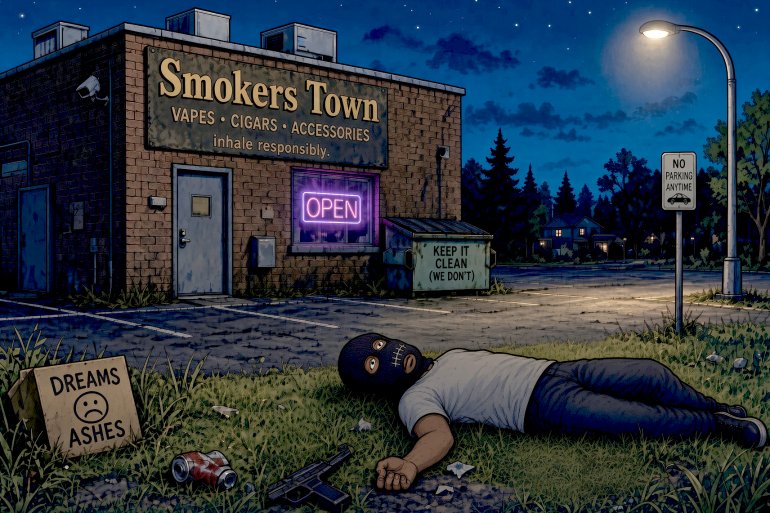
Raheem Brantley’s final moments at Smokers Town illustrate the brutal arithmetic of armed robbery: when the intended victim is faster on the draw, the math turns terminal in seconds. Brantley entered the store with the usual script—brandish, demand, escape—but the clerk’s practiced response rewrote the ending before Brantley could finish his first sentence. The footage shows the would-be robber staggering outside, already in physiological shutdown, collapsing on the grass that would become his unmarked grave. It’s a textbook demonstration of why the defensive-gun-use data keeps climbing: criminals who pick soft targets sometimes discover those targets aren’t soft at all.
For the 2A community, Brantley’s dirt nap is less tragedy than tutorial. Every frame of the incident reinforces the value of mindset, draw speed, and legal carry: the clerk didn’t need a committee meeting or a permission slip; he needed only the hardware and the willingness to use it. The result was one less predator on the street and zero additional victims, a ratio that rarely makes the evening news but happens daily across permit-holding America. Critics who claim “more guns, more bodies” conveniently omit the bodies that never appear because the gun stayed in its holster until the moment it mattered.
The larger implication is cultural. Stories like Brantley’s quietly recalibrate the risk calculation for every street criminal scrolling social media the next morning. When the grapevine carries word that corner-store clerks are shooting back—and winning—the marginal opportunist may decide the liquor store down the block looks less lucrative than a 9-to-5. That deterrence dividend costs taxpayers nothing, requires no new statutes, and flows directly from the individual right the Second Amendment was written to protect.


