

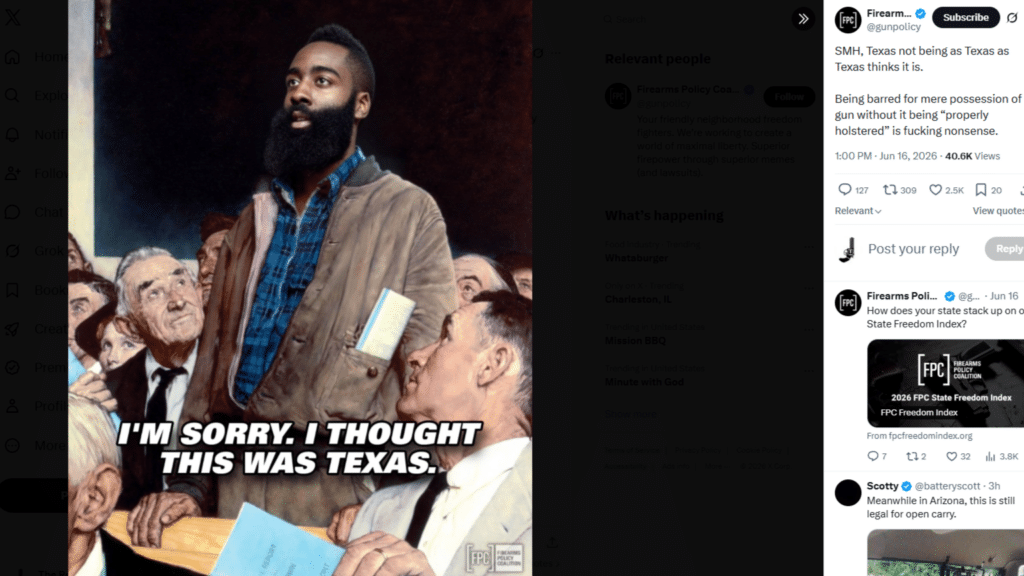
James Harden’s arrest in Texas has become the latest flashpoint in the endless tug-of-war over how states should treat licensed carriers who make a single mistake. Gun-rights organizations aren’t defending the NBA star’s conduct; they’re pointing out that Texas’s unusually harsh treatment of a shall-issue permit holder risks turning an otherwise law-abiding citizen into a felon for what amounts to a paperwork or momentary lapse. In a state that markets itself as a Second Amendment sanctuary, the optics of an out-of-state multimillionaire being booked while thousands of everyday Texans carry daily without incident expose the uneven application of “constitutional carry” that still hinges on perfect compliance with a thicket of administrative rules.
The deeper implication is that high-profile cases like this give anti-carry legislators fresh ammunition to argue that “more guns” inevitably means more problems, even when the data shows permitted carriers commit crimes at rates far below the general population. Groups such as the NRA and GOA are using Harden’s situation to underscore a broader warning: if states layer training mandates, notification requirements, and zero-tolerance penalties on top of permitless carry, they recreate the very discretionary system constitutional carry was meant to eliminate. For the 2A community, the takeaway is strategic—defend the right fiercely, but also demand that enforcement remain narrowly tailored so that isolated missteps don’t become lifetime disqualifiers that feed the narrative of the “irresponsible gun owner.”
Ultimately, the episode illustrates how culture-war flashpoints migrate quickly from the basketball court to the statute books. If Texas doubles down on punitive enforcement rather than refining its carry laws for clarity and proportionality, it hands national media a ready-made morality tale that will be replayed every time another permit holder trips over an obscure regulation. The organizations slamming the arrest are calculating that consistent, predictable, and fair rules will do more to protect the right to bear arms than any single high-profile prosecution.


