

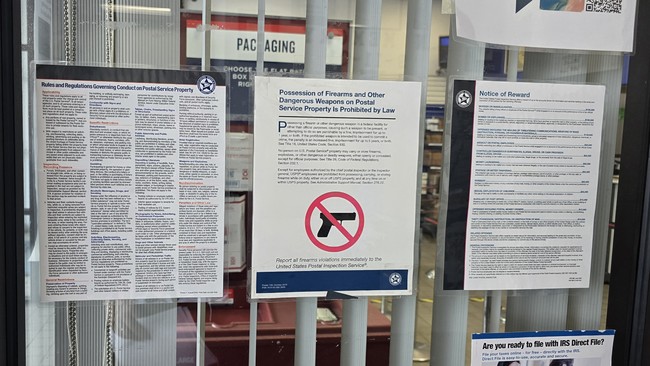
The Department of Justice’s recent filing in the Fifth Circuit is more than a procedural footnote—it’s a quiet but unmistakable admission that the Postal Service’s blanket prohibition on carrying firearms on its property sits on shaky constitutional ground. By arguing that the ban “contradicts federal law,” DOJ is effectively conceding that Congress never granted the Postal Service the sweeping authority it now claims, and that the restriction may run afoul of the plain text, history, and tradition test laid out in Bruen. For carriers and customers alike, this signals that the long-standing “no guns allowed” signs at post offices could soon join the growing list of restrictions courts are striking down as inconsistent with the Second Amendment.
What makes the development especially noteworthy is the identity of the messenger. The same administration that has championed expanded background checks and assault-weapon restrictions is now telling a federal appeals court that an agency under its own executive branch lacks the power to disarm law-abiding citizens on federal property. That internal tension exposes the selective nature of the current gun-control agenda: when the restriction is popular with anti-gun constituencies, agencies stretch their statutory authority; when the same logic threatens other policy priorities, the limits of that authority suddenly become clear. The 2A community should treat this filing as both validation and a roadmap—proof that even agencies long assumed to be beyond challenge can be forced to justify their rules under Bruen’s historical-analogue framework.
If the Fifth Circuit agrees, the ripple effects will extend well beyond post-office lobbies. A ruling that the Postal Service cannot unilaterally disarm citizens would undermine similar bans at other federal facilities and give renewed momentum to challenges against state-level “sensitive place” restrictions. More importantly, it would reinforce the principle that the right to bear arms is not a privilege doled out by bureaucratic whim, but a constitutional default that agencies must affirmatively overcome. For gun owners who have spent years navigating a patchwork of arbitrary prohibitions, the DOJ’s own words may prove to be the most effective chisel yet for chipping away at the edifice of “gun-free zones.”


