
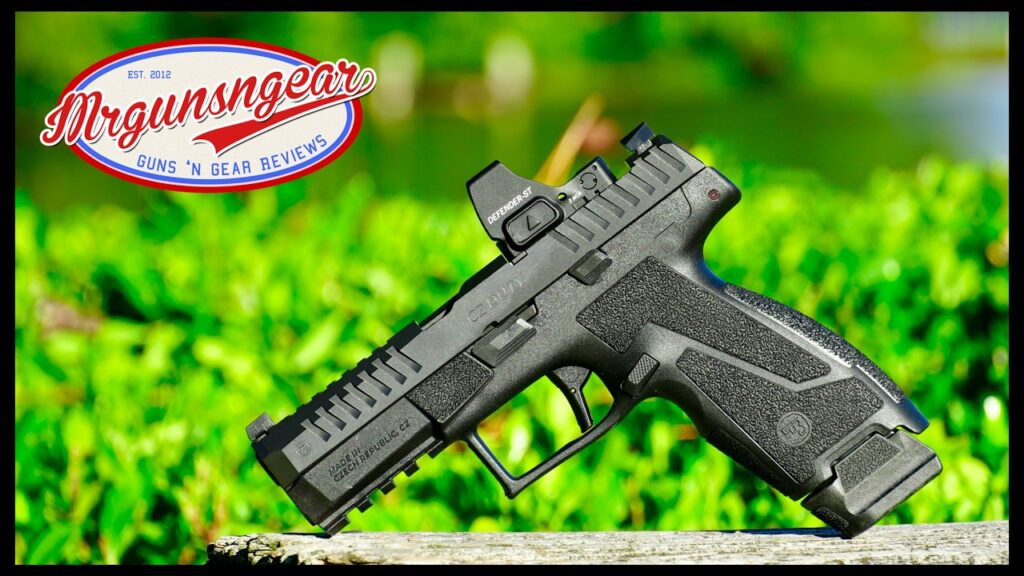
CZ’s new Duty Series — described in the review as the latest polymer “109” service pistol and the larger of the models in the lineup — arrives as a chassis-based duty gun rather than a conventional P-10C or P-10F clone. The reviewer received a pre-launch sample from CZ for range testing and disclosed that the company does not control the commentary. Four variants are planned, all built around a removable chassis that ATF treats as the firearm even as the host notes the legal definition is more theater than physics. Field-strip does not require a trigger pull. Three grip modules are expected at launch (the tested unit is treated as a mid-size), with extra modules said to appear on SIG Sauer’s site; a 19-round magazine sits slightly proud of the frame on the standard grip.
Ergonomics and controls
The host, who wears XL gloves, found the factory grip usable in 90-plus-degree heat with no slip, though he wanted slightly more aggressive texture on the front and backstrap. A modest beavertail, lanyard loop, undercut trigger guard, and oversized guard (aimed at gloved cold-weather use) round out the frame. Most controls are ambidextrous except the takedown lever. The reviewer dislikes a bilateral magazine release because a 3–4 o’clock carry can bump the off-side button against a wall and dump the mag. Slide stop/release is bilateral, well serrated, and did not snag his high-thumb grip across nearly 1,000 rounds. Thumb-safety and non-safety versions are both offered. A 1913 rail accepted lights without issue; launch holsters from several makers are already in the works.
Trigger, slide, and verdict
The trigger is the biggest departure from P-10 pistols: a Glock-like safety blade plus extra drop safeties, a consistent wall after reset, and a smoother, more even press than a stock Glock. Reset is longer than a P-10C’s hair-trigger reset. The host would still pick a P-10C for himself but called the Duty trigger logical for law-enforcement and military contracts and preferable to a Glock for most shooters. Angled front and rear slide serrations and a ventilated-style top cut complete the optic-ready slide. “It’s not a bad trigger. I want to be very clear on that point. It’s just completely different,” he said. “If I had to choose between this and a P-10C, I’d personally choose the P-10C. However, I think this gun is aimed at law-enforcement and military contracts, and in that regard it makes a lot of sense.”
Pros
- Chassis system with easy module swaps; no trigger pull for disassembly
- Glove-friendly guard, usable texture in heat, dual-side slide stop that did not false-activate
- Predictable, consistent trigger vs. stock Glock; extra drop safeties
- 1913 rail, launch holster support, optional thumb safety
Cons
- Ambidextrous mag release can dump a mag in 3–4 o’clock carry
- Texture milder than some prefer; thumb rest useless for very large hands
- Trigger feel will disappoint shooters who love the P-10C/P-10F break