

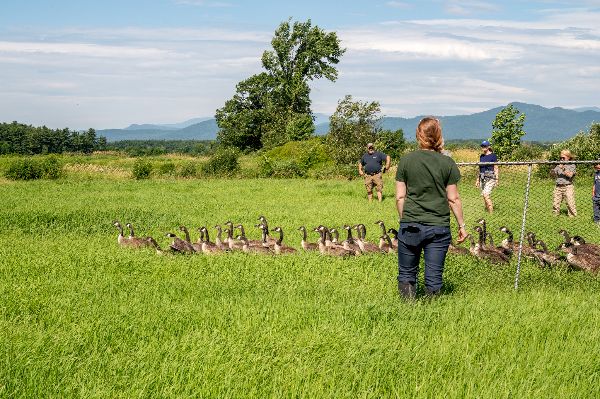
Vermont’s call for 40 volunteers to help round up and band Canada geese at Dead Creek isn’t just a routine wildlife-management exercise—it’s a vivid reminder that government agencies still rely on citizen participation when they want accurate, on-the-ground data. By enlisting ordinary outdoorsmen and women to handle, measure, and release the birds, the state tacitly acknowledges that boots-on-the-mud local knowledge often outperforms remote modeling. For Second Amendment supporters, the parallel is obvious: the same demographic that shows up at dawn with capture nets is the same demographic whose steady marksmanship and land-stewardship ethic keep both game populations and public-safety statistics in balance.
That volunteer pool also underscores a deeper policy truth—when agencies need help counting or moving wildlife, they rarely question the volunteers’ “assault” shotguns, high-capacity magazines, or semiautomatic rifles that might be resting in the truck for predator control or personal defense. The moment the mission shifts from geese to self-defense, however, those same tools suddenly become legislative targets. The inconsistency is glaring: if law-abiding citizens are trusted to handle live animals in close quarters, they can certainly be trusted to choose the most effective tools for defending life and property.
Finally, the banding data itself feeds into harvest regulations that ultimately rest on the individual right to keep and bear arms. Without accurate population counts, seasons get shortened, bag limits tighten, and opportunities for both sustenance and sport evaporate. In that sense, the goose roundup is more than an ornithological chore; it’s a small but tangible illustration that the right to arms and the right to hunt are two sides of the same constitutional coin—each reinforcing the other in the daily work of conservation.


