

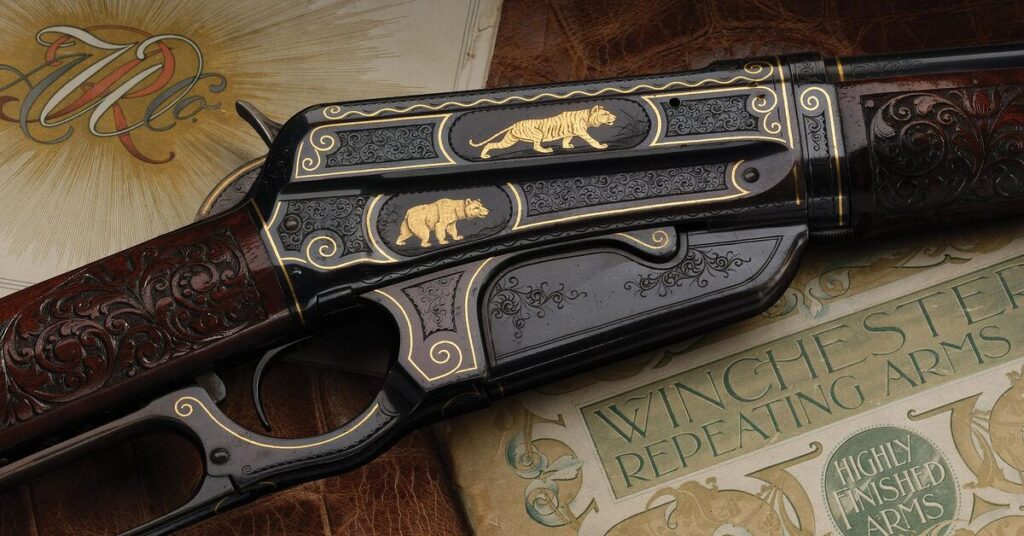
John Moses Browning’s late-1890s pivot from tube-magazine levers to the Winchester 1895 was more than a mechanical upgrade; it was a deliberate attempt to keep the lever gun relevant in an era when European militaries were already fielding Mausers and Mannlichers that could safely feed pointed, high-velocity spitzers. By moving the cartridge stack into a box magazine beneath the action, Browning gave the 1895 the ability to chamber the new .30-03 and .30-06 loads without the dangerous tip-to-primer contact that had doomed earlier tubular designs. The rifle that resulted was, in many ways, too refined for the rough-and-tumble jobs it was originally marketed to perform—Alaskan guides, Texas Rangers, and African hunters all carried them, yet the 1895’s smooth, controlled-feed action and strong locking lugs made it feel almost like a lever-action Mauser rather than a frontier workhorse.
That refinement carries a quiet lesson for today’s 2A community: innovation born of competition is what keeps civilian arms advancing. When Browning saw bolt-actions eating into Winchester’s market, he didn’t lobby for protectionist laws or regulatory barriers; he engineered a better lever gun that could run the same modern ammunition. The 1895’s subsequent adoption by the Texas Rangers and the Canadian North-West Mounted Police proved that private-sector ingenuity, not government mandate, drives capability. In an age when some politicians still push magazine-capacity limits and “assault weapon” bans under the guise of public safety, the 1895 stands as a reminder that the right to keep and bear arms has always included the right to keep and bear the most effective arms available—whether that means a 19th-century box-magazine lever or a modern semi-auto with standard-capacity magazines.
Collectors today often lament that many surviving 1895s are “too nice” for the hard service they were built to endure, yet that very durability is what makes them enduring symbols of American ingenuity. Their continued popularity among cowboy-action shooters, big-game hunters, and historical reenactors shows that a well-designed firearm doesn’t become obsolete just because a newer operating system appears; it simply finds new roles. For the 2A community, the 1895’s story reinforces a core truth: the Second Amendment protects not merely the right to own guns, but the right to own guns that work better than the ones that came before.


